The best flat pedals for most riders are a composite pedal like the OneUp Composite for value and a big platform, or an aluminum pedal such as the Crankbrothers Stamp 7 or Wolf Tooth Waveform for a thin, tough body in two sizes. Match the platform to your shoe size, look for replaceable pins and a standard 9/16" spindle, and ride them in flat-pedal shoes with a soft, flat rubber sole.
Independent & reader-supported. DrPedal doesn't sell anything. If you buy through our Amazon links we may earn a commission at no extra cost to you — as an Amazon Associate we earn from qualifying purchases. How we make money.
Top picks
Chosen from current models on manufacturer specs, compatibility and design — not sponsored placements. Amazon buttons open a search for the exact model.
Best for: Trail riders on a budget and riders with bigger feet
A big 115 x 105 mm nylon platform with 10 rear-loading steel pins per side held by Nyloc nuts, so a bent pin unscrews from behind. OneUp lists the standard size at 355 g.
Best for: New flat-pedal riders, e-MTB and trail bikes
The updated Chester comes in small and large with nine metal plus two molded pins per side and a 16 mm platform height. Older 2019–2023 Chesters had 8 pins per side, so check the version.
Best for: Trail riders who want serviceable internals
A 110 x 105 mm composite platform about 17 mm thick, nine bottom-loading pins per side and a CroMo spindle on a rebuildable bearing-and-bushing system. Listed at 380 g per pair.
Best for: Riders who want the platform sized to their shoe
Small fits roughly US 5–10 and large US 10–15. Forged 6061-T6 body, chromoly spindle, 10 adjustable pins per side; listed at 345 g (small) and 375 g (large) per pair.
Best for: Wet-weather riders who want a thin concave pedal
A concave 6061-T6 body 14 mm thick at the edges and 12.5 mm in the center, a 17-4 PH stainless axle and 11 stainless pins per side, with six spare pins in the box.
Spank sizes the Spoon by width: 90 for US men's 6 and under, 100 for 7–10, 110 for 11 and up. The 100 has a 16–12 mm concave profile and 10 steel pins per side.
An asymmetric 2014-T6 aluminum body on a CroMo axle with three cartridge bearings plus an Igus bushing, and 11 pins per side. Hope states 360 g per pair with all pins fitted.
Choose flat pedals by platform size first, then pins, thickness and bearings. Thread size only matters on kids’ and BMX bikes.
Platform size vs shoe size
Your shoe should cover most of the platform. Too small and the sole hangs off the front and back, so the edge pins can’t hold it; too big and the pedal catches rocks.
Small feet (roughly US 5–9): Stamp 7 small, Waveform small, or the Spank Spoon 90 or 100.
Average feet (US 8–10): one-size pedals around 100–110 mm, such as the SDG Comp or Spank Spoon 100.
Big feet (US 10 and up): Stamp 7 large, Waveform large, Spoon 110 or the 115 x 105 mm OneUp Composite.
Makers list dimensions in different orders, so compare like with like.
Pins: count, height and loading
Most good flat pedals have 9–11 replaceable pins per side, set around the edges. Taller pins grip harder but make it harder to reposition your foot and hurt more if you slip.
Back-loading pins thread in from underneath, so a smashed head on top doesn’t stop you removing them. Top-loading pins are simpler but can round out after rock strikes. See our pedal pins guide.
Concave and thickness
Concave means the center of the platform sits lower than the edges, so the sole cups into it: the Wolf Tooth Waveform is 14 mm at the edges and 12.5 mm in the middle.
A thinner body puts your foot closer to the spindle, so the pedal is less inclined to roll under your foot, and it gives more ground clearance. Composite pedals are usually a little thicker than alloy ones.
Bearings and bushings
The body spins on cartridge bearings, bushings (DU or Igus types) or a mix. Many good designs pair an inboard bushing with outboard bearings, as the Hope F22 does. Whatever the layout, choose a pedal whose maker sells a service kit.
Thread size: 9/16” vs 1/2”
Adult bikes use 9/16” x 20 TPI pedal threads. One-piece cranks (some kids’, BMX and cruiser bikes) take 1/2” pedals, and the two never interchange. The left pedal is reverse-threaded: see which pedal is reverse threaded.
Composite vs aluminum
Composite (nylon) pedals are the value choice: light, tough and they skid off rocks rather than denting. Aluminum pedals can be machined thinner and hold pins in metal threads, which is why most premium flats are alloy.
Shoes: flat-pedal MTB shoes vs sneakers
Flat-pedal MTB shoes: a soft, sticky rubber sole with a flat tread the pins sink into, plus a stiffer midsole. Best for trail, enduro and downhill.
Flat-soled skate shoes: fine for commuting, dirt jumps and short rides.
Running shoes: poor; deep lugs and soft foam let the pins wander.
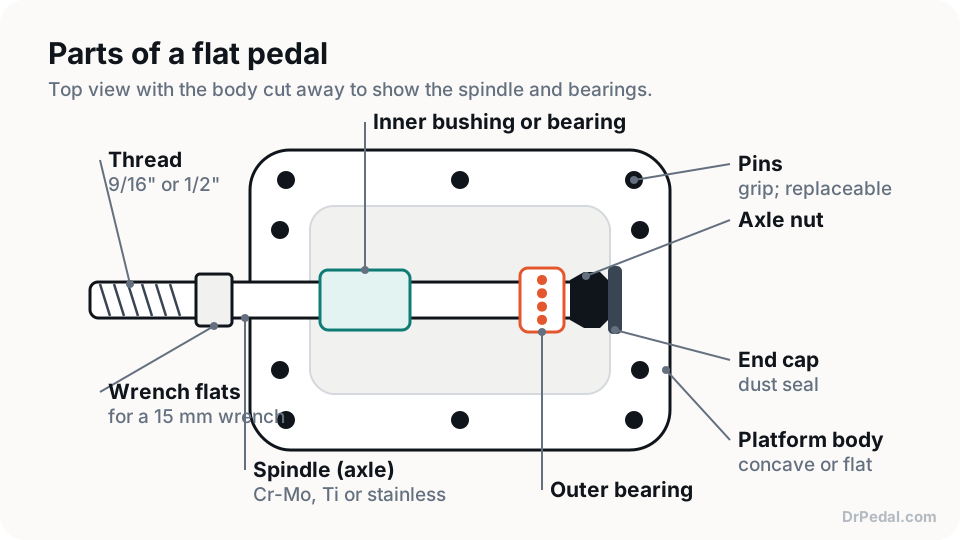
Pedal anatomy: the parts of a flat pedal
A flat pedal is a body spinning on a spindle, carried by bearings, with pins for grip. From the crank outward:
Anatomy of a flat pedal, with the body cut away to show the spindle, bushing and bearing.
Thread — screws into the crank: 9/16” x 20 TPI on adult cranks, 1/2” on one-piece cranks. Left pedals are reverse-threaded and usually marked “L”.
Wrench flats and hex socket — 15 mm flats for a pedal wrench and/or a 6 mm or 8 mm hex socket reached from behind the crank. Many modern flats have the hex only (pedal tools).
Seal — a rubber lip seal at the crank end that keeps water and grit out.
Spindle (axle) — the steel shaft the body rotates around, usually chromoly; see pedal spindles.
Bearings and bushings — cartridge bearings, loose balls or DU/Igus bushings that let the body spin.
Body (platform) — the part you stand on: nylon composite, or extruded, forged, die-cast or CNC-machined aluminum.
Concave — the dish in the top surface.
Profile (thickness) — the body’s height, quoted at the edge and center.
Leading edge — the front and rear edges, often chamfered to glance off rocks.
Pins — threaded studs (or molded nubs on budget nylon pedals) that bite into the sole.
End cap (dust cap) — covers the axle nut on the outer end; removing it starts a bearing service.
Reflectors — common on commuter platforms, rare on MTB flats.
A wobbly pedal points to parts 4 and 5 (worn bushings or loose bearings); a slippery one points to part 10 and your shoes.
What “pedality” means: how to judge pedal quality
“Pedality” is not a pedal brand, model or bike-industry term; it may be a typo or shorthand for pedal quality. A quality flat pedal has:
Replaceable pins threaded into the body, not molded in.
Serviceable bearings or bushings, with spare parts sold by the maker.
A thin, concave platform sized to your shoe.
A strong chromoly or stainless spindle with a standard 9/16” thread.
Every pick on this page meets those points.
Pedales flat: qué son y cómo elegirlos
Los pedales flat (también llamados pedales planos o de plataforma) son pedales sin enganche: el pie se apoya sobre una plataforma ancha con pines metálicos que se clavan en la suela. No necesitan calas ni zapatillas especiales, aunque una zapatilla de MTB para pedal plano, con suela de goma blanda y plana, agarra mucho mejor. Para elegirlos, fíjate en el tamaño de la plataforma según tu talla de pie, en que los pines sean reemplazables y en la rosca: casi todas las bielas de adulto usan 9/16”.
Grease the threads, start each pedal by hand and tighten firmly; the left pedal tightens anticlockwise. Replace bent pins before the threads in the body get damaged, and rebuild the axle with the maker’s service kit and fresh grease as soon as it develops play.
Flat pedals are platform pedals with no cleat: your shoe sits on a wide body and small metal pins bite into the sole. You can put a foot down instantly and ride in any shoe.
What does "pedality" mean?
+
It isn't a pedal brand or an industry term, and no pedal is sold under that name. People searching it usually want to know what makes a good pedal; see the pedal quality checklist above.
What are "pedales flat"?
+
It's Spanish for flat pedals (also pedales planos or de plataforma): pinned platforms ridden without cleats. The buying advice here applies the same.
What size flat pedal do I need?
+
Pick by shoe size. Crankbrothers suggests the small Stamp for roughly US 5–10 and the large for US 10–15; Spank makes the Spoon 90, 100 and 110 for small, medium and large feet.
Do I need special shoes for flat pedals?
+
No, but they help. Flat-pedal MTB shoes have a soft, flat rubber sole the pins sink into and a stiffer midsole. Flat-soled skate shoes work reasonably; lugged running shoes grip poorly.
Composite or aluminum flat pedals?
+
Composite pedals are cheaper and skid off rocks without denting, but are usually a little thicker. Aluminum pedals can be thinner and hold pins in metal threads, but cost more.
What thread do flat pedals use?
+
Adult flat pedals use a 9/16" x 20 TPI spindle. One-piece cranks on some kids', BMX and cruiser bikes need 1/2" pedals. The left pedal is reverse-threaded: see which pedal is reverse threaded.
Why do my feet slip on flat pedals?
+
Usually worn pins, hard or lugged soles, or a platform too small for your foot. Replace bent pins (pedal pins guide) and try a softer-soled flat-pedal shoe.