The best pedal removal tool is a dedicated 15 mm pedal wrench such as the Park Tool PW-5, because its thin head fits the narrow flats and its long handle gives leverage. If your pedals have no wrench flats, use a long 6 mm or 8 mm hex key from behind the crank. For either tool, turn the top of the tool toward the back of the bike to loosen both pedals, since the left pedal is reverse-threaded.
Independent & reader-supported. DrPedal doesn't sell anything. If you buy through our Amazon links we may earn a commission at no extra cost to you — as an Amazon Associate we earn from qualifying purchases. How we make money.
Top picks
Chosen from current models on manufacturer specs, compatibility and design — not sponsored placements. Amazon buttons open a search for the exact model.
Best for: Home mechanics swapping pedals a few times a year
A 15 mm pedal wrench with a thin head that slips between the pedal body and the crank, and a handle long enough for normal removal. It covers the large majority of pedals with wrench flats.
Best for: Workshops, fleets and anyone fighting a seized pedal
Park's shop-grade 15 mm wrench has a longer handle than the PW-5, so you get more leverage on a pedal that has been in for years. It is the one to buy if you work on other people's bikes.
Best for: Mechanics who also see older pedals with 9/16" flats
A double-ended pedal wrench with a 15 mm opening at one end and a 9/16" opening at the other. The second size covers older pedals that do not take a 15 mm wrench.
Best for: Riders who want a sturdy 15 mm pedal wrench from another workshop brand
Pedro's makes a dedicated 15 mm pedal wrench with a thin head for pedal flats. It does the same job as the Park Tool wrenches; choose whichever handle and grip you prefer.
Best for: Pedals with an 8 mm hex socket and no wrench flats
Many road and flat pedals have no 15 mm flats, only a hex socket in the spindle end. A long single-size hex wrench gives more leverage than a folding multi-tool. Check whether your pedal needs 6 mm or 8 mm before buying.
Best for: Fitting pedals to the maker's torque, especially on carbon cranks
A ratcheting click-type torque wrench covering 10 to 60 N·m, which spans common pedal specs. Use it with a hex bit, or with a 15 mm crowfoot head for pedals with wrench flats.
Look at your pedal first: if it has two flat faces on the spindle between the pedal body and the crank, you need a 15 mm pedal wrench. If it has a hex socket in the end of the spindle (seen from behind the crank arm), you need a 6 mm or 8 mm hex key. Many pedals have both.
15 mm pedal wrench
Compared with a normal 15 mm spanner, a pedal wrench has:
A thin head that fits the narrow wrench flats on modern pedals.
A long handle for the leverage a tight or corroded pedal needs.
Offset openings on many models, so you can find an angle that clears the crank.
Older pedals on some vintage and kids’ bikes take a 9/16” wrench instead; the Park Tool PW-3 has both sizes.
6 mm or 8 mm hex key
Hex-only pedals are common on lightweight road and flat pedals. Use a long, single-size hex wrench, not a multi-tool, and push it fully into the socket before applying force so it does not round out.
Torque wrench
A torque wrench is optional for most riders but worth it on carbon cranks. Pedals need much more torque than stem or seatpost bolts, so a small 2–14 N·m wrench will not reach. Choose one that covers the pedal maker’s figure, such as the Park Tool TW-6.2 (10–60 N·m). For pedals with flats, add a 15 mm crowfoot head; for hex pedals, a hex bit.
Which way to turn a pedal removal tool
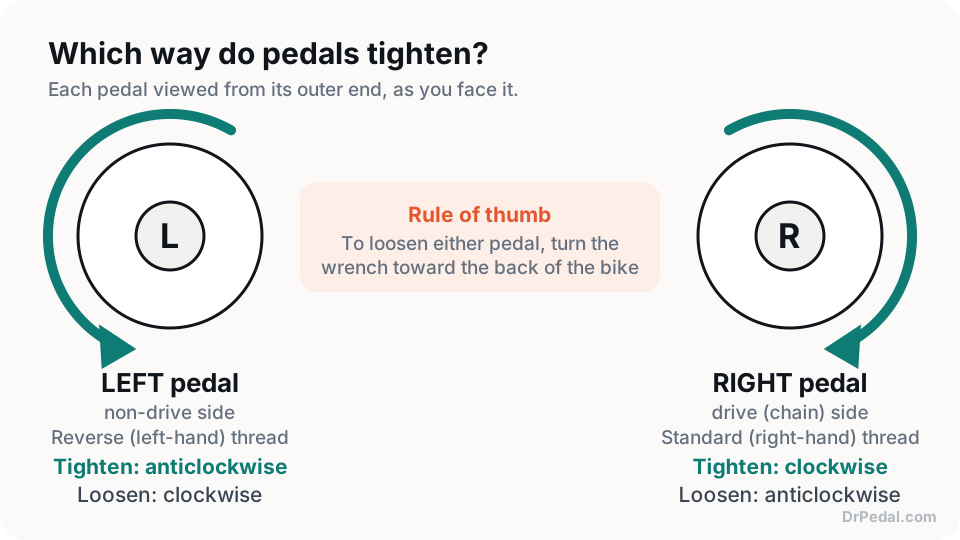
Turn the top of the tool toward the back of the bike to loosen, on both sides. The right (drive-side) pedal has a normal thread and loosens counterclockwise; the left pedal is reverse-threaded and loosens clockwise when viewed from that side.
The left pedal is reverse threaded. To loosen either pedal, turn the wrench toward the back of the bike.
Pedal
Thread
Loosen
Tighten
Right (drive side)
Normal (right-hand)
Counterclockwise
Clockwise
Left (non-drive side)
Reverse (left-hand)
Clockwise
Counterclockwise
Directions are judged from outside the bike. With a hex key from behind the crank you view it from the other side, so stick with the “toward the back” rule. Why the left pedal is reverse-threaded: which pedal is reverse threaded.
How to remove a stuck pedal
A stuck pedal usually comes free with better leverage, penetrating oil and patience. Work through these steps in order:
Check the direction. Most “seized” pedals are being turned the wrong way. Top of the tool toward the back of the bike.
Use the squeeze method. Shift to the big chainring to cover the teeth. Put the crank arm forward and horizontal, fit the wrench pointing up and slightly back so it forms a V with the crank arm, then squeeze the wrench toward the crank.
Use a longer tool. A long pedal wrench such as the Park Tool PW-4, or a long hex wrench, multiplies your effort. Do not slip a pipe over a short hex key; it tends to round the socket.
Apply penetrating oil. Spray where the spindle enters the crank, from both sides, and wait several hours or overnight before trying again.
Try a sharp tap. With the wrench fitted, a firm blow on the handle with a rubber mallet can break corrosion where steady pressure cannot.
Stop before you damage the crank. If the flats or hex socket start to round, or the crank is carbon, take it to a bike shop. Never heat a carbon crank.
Once it is out, clean and inspect both threads; the guide covers stripped-thread repairs.
How to install pedals correctly
Grease, start by hand, then tighten firmly. Pedals marked L and R go on the matching side.
Clean both threads and apply a thin coat of grease (anti-seize for titanium spindles), plus a pedal washer if your crank maker supplies one.
Start each pedal by hand, turning toward the front of the bike, for several full turns. If it binds, back it out and restart.
Tighten with the pedal wrench or hex key, or to the maker’s torque, and re-check after the first ride.
Pedal tools by bike type
Bike / pedal
Likely tool
Most flat and SPD pedals
15 mm pedal wrench, often also 6 mm or 8 mm hex
Lightweight road pedals
8 mm (sometimes 6 mm) hex, sometimes 15 mm flats
Kids’, BMX and cruiser bikes with one-piece cranks
A 15 mm pedal wrench for pedals with wrench flats, or a 6 mm or 8 mm hex key for pedals with a hex socket in the spindle end. Many pedals accept both.
Can I use a regular 15 mm wrench to remove pedals?
+
Sometimes. A standard combination wrench is often too thick to fit the narrow flats between pedal and crank, and too short for a tight pedal. A dedicated pedal wrench is thinner and longer.
Which way do you turn a pedal removal tool?
+
Turn the top of the tool toward the back of the bike to loosen either pedal. The right pedal loosens counterclockwise and the left (reverse-threaded) pedal loosens clockwise. Full detail in our reverse-thread guide.
What size Allen key fits bike pedals?
+
Usually 6 mm or 8 mm, inserted into the end of the spindle from behind the crank arm. Some pedals take only one size, so check yours.
How tight should bike pedals be?
+
Use the pedal maker's figure. Shimano, for example, specifies 35–55 N·m for its pedals. Without a torque wrench, tighten firmly with a pedal wrench but do not stand on it.
Do I need a torque wrench for pedals?
+
It is not essential for most riders, but it helps on carbon cranks. You need one that reaches the pedal maker's figure, plus a crowfoot or hex bit.