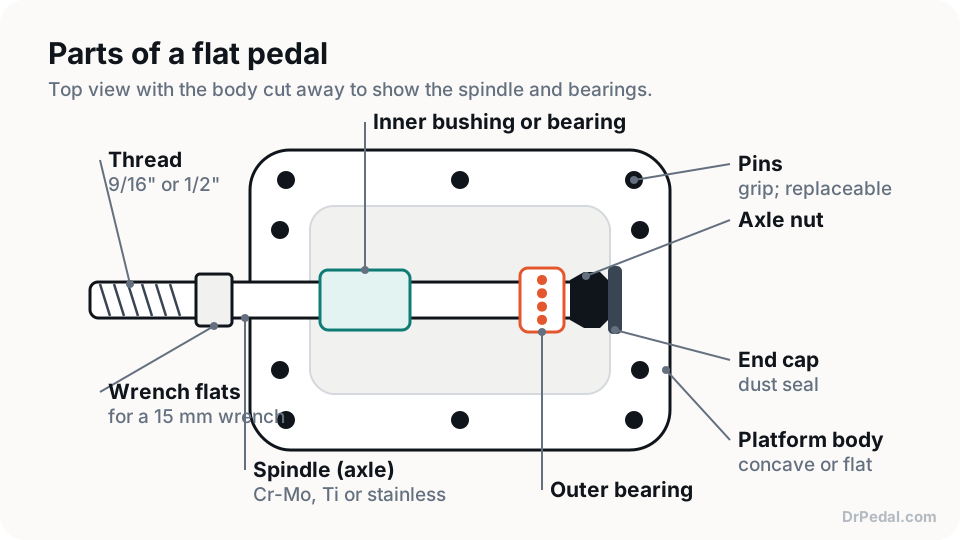
A bicycle spindle usually means the pedal spindle: the steel or titanium axle that threads into the crank arm and carries the pedal body on its bearings. Spindles are model-specific, so if yours is bent or the bearings feel rough, buy the factory part for your exact pedal (a Shimano axle unit or a Crankbrothers rebuild kit) rather than a "universal" spindle. If you want a wider stance, choose a longer-spindle pedal such as Shimano's +4 mm road models or the Crankbrothers Mallet E LS instead of stacking washers.
Independent & reader-supported. DrPedal doesn't sell anything. If you buy through our Amazon links we may earn a commission at no extra cost to you — as an Amazon Associate we earn from qualifying purchases. How we make money.
Top picks
Chosen from current models on manufacturer specs, compatibility and design — not sponsored placements. Amazon buttons open a search for the exact model.
Best for: Riders with a bent or worn spindle in a Shimano pedal they want to keep
Shimano sells the complete axle assembly (spindle, bearings, cones and seal) as a spare part for many SPD and SPD-SL pedals. It threads into the pedal body as one unit, so you replace the whole moving part, not just a bare rod. Order by your pedal's model number (PD-M520, PD-R8000 and so on) because the units are not interchangeable.
Best for: Eggbeater, Candy, Mallet and Double Shot owners with gritty or loose pedals
Crankbrothers pedals run on a cartridge bearing plus a bushing, and the brand sells kits with the wear parts (bearing, bushing and seals) so you can refresh the spindle area without buying new pedals. Kits differ by pedal generation, so match the kit to your model and year before ordering.
Best for: Enduro and e-MTB riders who want a wider stance or more heel clearance
The LS in the name stands for long spindle: it is the Mallet E clipless-with-platform pedal with a longer axle than the standard version, which moves your feet outward without spacers. It uses Crankbrothers' 2-bolt cleats (6° float on the standard cleat).
Best for: Road riders with wide hips, a toes-out foot angle or heels that brush the crank
Shimano offers the Ultegra SPD-SL pedal in a version with an axle 4 mm longer than standard, widening your stance on each side without changing cleats or shoes. Dura-Ace PD-R9100 has the same +4 mm option if you want the premium body.
Best for: Weight-conscious road riders who like Speedplay's adjustable float
The Nano is the Speedplay model with a titanium spindle; the Comp uses chromoly and the Zero and Aero use stainless steel, so the range shows the three spindle materials side by side. It uses the 4-hole Speedplay cleat (3-hole adapter included) with 0–15° adjustable float on Standard Tension cleats. Titanium spindles can carry a rider-weight limit, so check Wahoo's current spec sheet before you buy.
Best for: Cross-country and gravel riders shaving grams on a 2-bolt system
A double-sided, SPD-compatible clipless pedal built around a titanium spindle. It is a simple way to get a Ti axle on a 2-bolt system; as with any titanium spindle, use anti-seize on the threads.
Bike spindle, BB spindle or hub axle: which one do you need?
“Spindle” is used for three different parts, and ordering the wrong one is the most common mistake.
Part people call a “spindle”
Where it is
What decides compatibility
Pedal spindle
Inside each pedal, threaded into the crank arm
Pedal brand and model; 9/16” or 1/2” thread
Bottom-bracket (crank) spindle
Runs through the frame and joins the two crank arms
Crank standard: square taper, Shimano Hollowtech II (24 mm), SRAM DUB (28.99 mm), 30 mm and others
Hub axle
Center of each wheel
Quick-release or thru-axle size (for example 12 mm or 15 mm thru-axles)
Bottom-bracket spindles and hub axles are matched to your crank or hub standard, not to your pedals. The rest of this page is about pedal spindles.
What a pedal spindle does
Your whole pedaling force passes through the spindle. One end threads into the crank; the other carries the pedal body on bearings, bushings or both.
The spindle threads into the crank and carries the pedal body on a bushing and bearings.
A threaded end: 9/16” x 20 TPI on most adult bikes, 1/2” x 20 TPI on one-piece cranks. The left spindle is reverse-threaded.
Wrench fittings: 15 mm flats, a 6 mm or 8 mm hex socket in the end, or both.
Bearing seats: where the cartridge bearings, needle bearings, bushings or cup-and-cone balls sit.
A retaining nut or axle unit: what holds the body on. Shimano uses a self-contained axle unit; Crankbrothers uses a nut under an end cap.
How to choose a pedal spindle
The right pedal spindle is the one made for your exact pedal. After that, you choose on material and length.
Match the pedal model first
Spindles are not interchangeable between brands, and often not between generations of the same pedal. Look for the model number on the pedal body or spindle (Shimano prints codes such as PD-M520 or PD-R8000) and order the spare part listed for that model. If no part exists, a new pair of pedals is the answer.
Thread size: 9/16” or 1/2”
Every spindle is made for one thread. Adult bikes with three-piece cranks use 9/16”; kids’, BMX and cruiser bikes with one-piece cranks use 1/2”. You cannot re-thread a spindle, so a 9/16” pedal will not fit a 1/2” crank. Our reverse-thread guide covers how to tell the threads apart.
Spindle material: Cr-Mo, stainless or titanium
Chromoly (Cr-Mo) steel is the default on most pedals. It is strong, stiff and tends to bend before it breaks, which gives you a warning.
Stainless steel spindles resist corrosion, which helps riders in wet or salty conditions. Wahoo’s Speedplay Zero and Aero use stainless spindles.
Titanium saves weight and does not rust, but it is less stiff than steel, can gall (cold-weld) in the crank threads if fitted dry, and is sometimes sold with a rider-weight limit. Always use anti-seize on Ti threads; see pedal grease and anti-seize. The Look Keo Blade Carbon Ceramic is a good example of a pedal sold in both chromoly and titanium spindle versions.
Spindle length and Q-factor
A longer spindle moves your foot further from the crank. Q-factor is the width between the outer faces of the crank arms; your actual stance width adds the spindle length on each side, plus how far inboard or outboard your cleats sit.
Consider a longer spindle if:
your heels or ankles brush the crank arms or chainstays,
your knees track outward at the top of the stroke, or
you have already moved your cleats fully inboard and still want more width.
Shimano sells several road pedals in a +4 mm version, and Crankbrothers labels its long-spindle pedals “LS”. A bike fitter can confirm whether you need it.
Bearings, bushings and serviceability
How the spindle runs inside the body decides how you will service it:
Cup-and-cone ball bearings (most Shimano pedals, MKS pedals): adjustable, and they last a long time if kept greased.
Cartridge bearing plus bushing (Crankbrothers and many flat pedals): you replace the wear parts with a kit.
Multiple sealed cartridge bearings (many premium flat pedals): smooth and simple to replace with the right bearing press or puller.
Wrench flats or hex only?
Some spindles have 15 mm flats, some only a 6 mm or 8 mm hex socket, and some both. Check before you buy a pedal removal tool.
Longer spindles vs washers vs pedal extenders
A longer factory spindle is the cleanest way to widen your stance. It keeps full thread engagement and the pedal maker designed the bearing load around it.
Option
Typical change
Trade-off
Thin pedal washer
Around a millimeter
Protects the crank face; adds very little width
Longer factory spindle (+4 mm, LS)
A few millimeters per side
Best option; limited to models that offer it
Bolt-on pedal extender
Much more
Adds a second threaded joint and more leverage on the crank threads
Stacking several pedal washers to gain width is a bad idea: every millimeter of washer is a millimeter of thread that is no longer in the crank.
Signs of a bent bicycle spindle
A bent spindle shows up as a wobble you can see and, often, a knee or ankle ache you can feel. Common causes are pedal strikes and crashes.
Check it in a minute:
Shift so the chain is clear, then turn the crank slowly backward.
Watch the outer end of the pedal against a fixed reference, such as the chainstay or a pen held close to it.
If the end traces a circle, or the gap between the pedal body and the crank changes as you turn, something is bent.
Fit a known-good pedal to the same crank. If it runs true, the old spindle is bent; if it also wobbles, the crank arm is the problem.
Never straighten a bent spindle. Bending and re-bending steel fatigues it, and a spindle that snaps mid-sprint causes serious crashes. Replace it.
Rebuild or replace?
Rebuild when the spindle is straight but the pedal feels rough, loose or gritty. Replace when the spindle is bent, the threads are damaged or the body is cracked.
Symptom
Likely cause
Fix
Rough or gritty spin
Dirty or dry bearings
Clean and re-grease, or fit a rebuild kit
Side-to-side play
Worn bushing or loose cone
Adjust cones (Shimano) or replace bushing (Crankbrothers)
Visible wobble
Bent spindle
New spindle or axle unit
Cracked body
Impact
New pedals
Most riders can fit a Shimano axle unit or a Crankbrothers kit at home with basic tools and a good bearing grease such as Park Tool PolyLube 1000. The general sequence is:
Remove the pedal from the crank, remembering the left one is reverse-threaded.
Clamp the spindle flats gently in a vise with soft jaws, or hold them with a wrench.
Remove the end cap or unthread the axle unit, following the maker’s service guide for direction and tools.
Slide the spindle out, clean every part and inspect the bearing surfaces.
Fit new bearings, bushings or seals, grease generously and reassemble.
Check the pedal spins freely with no play, then refit it with grease on the threads.
On a pedal, the spindle is the axle that threads into the crank and that the pedal body spins around. People also say "bike spindle" for the bottom-bracket spindle that joins the two crank arms, and occasionally for a hub axle, so check which part you mean before you order.
Can you replace just the spindle on a bike pedal?
+
Often, yes. Shimano sells complete axle units for many pedals and Crankbrothers sells rebuild and spindle parts, but you must match the exact pedal model. If the maker no longer supplies parts for your pedal, replacing the pedals is the safer option.
Are pedal spindles universal?
+
No. The thread into the crank is standard (9/16" for most adult bikes, 1/2" for one-piece cranks), but the part inside the pedal body (bearing seats, length, retaining nut) is specific to each brand and model.
What size thread is a pedal spindle?
+
Most adult bikes use 9/16" x 20 TPI. Kids', BMX and cruiser bikes with one-piece cranks use 1/2" x 20 TPI. The left spindle is reverse-threaded; see which pedal is reverse threaded.
How do I know if my pedal spindle is bent?
+
Turn the crank slowly backward and watch the outer end of the pedal against a fixed point. If it traces a circle or the gap to the crank arm changes, either the spindle or the crank arm is bent. Swap in a known-good pedal to tell which.
Are titanium pedal spindles worth it?
+
Only if saving weight matters to you. Titanium is lighter than steel but less stiff, often comes with a rider-weight limit, and needs anti-seize on the threads. Chromoly steel is the durable default.
What length pedal spindle do I need?
+
Start with the standard length. Go longer (Shimano +4 mm, Crankbrothers LS) if your heels brush the crank, your knees track outward, or you have already moved your cleats fully inboard and still want a wider stance.