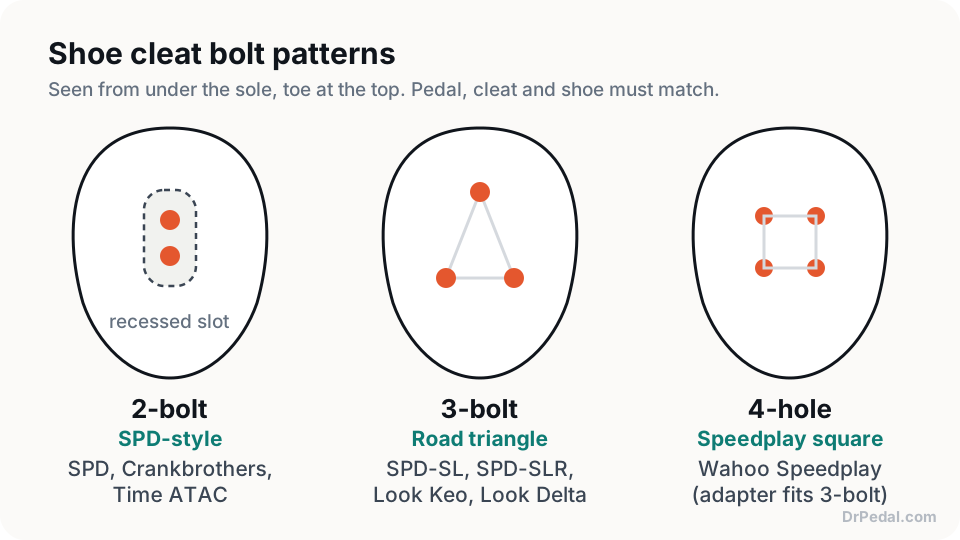
SPD vs SPD-SL is walking versus platform: SPD is Shimano's 2-bolt system with a small cleat recessed into a shoe you can walk in, while SPD-SL is its 3-bolt road system with a large cleat and a wider pedal. Look Keo is the main road alternative to SPD-SL: same 3-bolt shoe, different cleat, more float choices. Pick SPD for commuting, touring, gravel, mountain biking and spin classes; pick SPD-SL or Look Keo for road riding.
Independent & reader-supported. DrPedal doesn't sell anything. If you buy through our Amazon links we may earn a commission at no extra cost to you — as an Amazon Associate we earn from qualifying purchases. How we make money.
One proven pedal for each system
Chosen on compatibility, specs and design — not sponsored. Amazon buttons open a search for the exact model.
Best for: Commuting, touring, gravel, spin bikes and first clipless pedals
The benchmark double-sided SPD pedal: clip in from either side, adjust the release tension, and walk normally on the recessed 2-bolt cleat. Single-release SM-SH51 cleats come in the box.
Best for: Road riders who want Shimano's road cleat system
Shimano's mid-range SPD-SL pedal has a wide carbon-composite body, adjustable tension and yellow SM-SH11 cleats (6° float) in the box. The same cleats fit Ultegra and Dura-Ace SPD-SL pedals.
Look's entry-level Keo pedal takes the same Keo cleats as the premium Keo Blade models, so cleats and cleat position carry over if you upgrade. The Keo Classic 3 Plus adds a stainless steel contact surface.
Read the table as two families: 2-bolt systems (SPD, Crankbrothers) built around a shoe you can walk in, and 3-bolt or 4-hole systems (SPD-SL, SPD-SLR, Keo, Speedplay) built around a big, stiff road platform. Pedals for every system are in our clipless pedals guide.
SPD vs SPD-SL: same brand, different jobs
SPD and SPD-SL are both Shimano, but the pedals, cleats and usually the shoes are all different.
Cleat and shoe. SPD’s small metal cleat bolts into a 2-bolt channel and sits inside the tread, so the shoe walks like a stiff sneaker. SPD-SL’s wide plastic cleat bolts to a 3-bolt road sole and stands proud of it.
Platform. SPD-SL spreads your pedaling load over a wider pedal and cleat. SPD concentrates it on a smaller area, so stiffer soles help on long days.
Entry. Most SPD pedals are double-sided: step down and you are in. SPD-SL pedals are single-sided and hang tail-down, so you hook the front lip with the cleat’s nose, then press down.
Release. Both release with an outward heel twist, with tension set on the pedal. Only SPD offers a multi-release cleat (SM-SH56).
Float. SPD cleats give 4°. SPD-SL lets you choose 0°, 2° or 6° by cleat color.
Dirt. SPD copes with mud; SPD-SL cleats clog and wear quickly if you walk on them outdoors.
Choose SPD if you walk at all on your rides, ride off-road, or want one pair of shoes for the gym bike, the gravel bike and the commute. Choose SPD-SL if you ride mostly on the road and barely walk in your cycling shoes. Plenty of experienced tourers and long-distance riders run SPD on drop-bar bikes for the walking alone; it is not a beginner’s compromise.
SPD vs Look Keo
SPD vs Look Keo is the same trade-off as SPD vs SPD-SL, because Keo is a road system: a wide 3-bolt plastic cleat on a stiff road shoe. Keo Grip cleats add rubber pads for café floors, but you still walk on your heels. The real question is the shoe you want to wear.
SPD-SL vs Look Keo: the real road decision
SPD-SL and Look Keo are close rivals: same 3-bolt road shoe, wide single-sided pedal, heel-twist release. Most riders would be happy on either, so decide on the details.
Shimano SPD-SL
Look Keo
Float choices
0°, 2°, 6°
0°, 4.5°, 9°
Most float available
6° (yellow)
9° (red)
Tension
Screw on every pedal
Screw on Keo Classic models; carbon blade spring on Keo Blade models
Walking help
Shimano cleat covers
Rubber pads on Keo Grip cleats; Look cleat covers
One cleat across the range
105 PD-R7000, Ultegra PD-R8000, Dura-Ace PD-R9100
Keo Classic 3 up to Keo Blade Ceramic
How to decide:
Your knees like to move: Look’s red 9° cleat gives more freedom than any SPD-SL cleat. See cleat float explained.
You want a planted feel with a little give: Shimano’s blue 2° cleat has no Keo equivalent.
You already own one system: stay with it. Cleats and cleat position carry across the whole range, so upgrading costs a pedal, not a new setup.
You walk mid-ride: Keo Grip pads help, or carry cleat covers for either system.
More on each range on the Shimano and Look brand pages.
Where SPD-SLR fits
SPD-SLR is Shimano’s newest road system, used by the Ultegra PD-R8200 and Dura-Ace PD-R9300 and supplied with CL-SL110 cleats. Per Shimano, it gives a lower stack and easier engagement than SPD-SL.
The cleats still bolt to any 3-bolt road shoe, but major retailers state that SPD-SLR cleats are not compatible with SPD-SL pedals. Treat it as its own system: SPD-SLR pedals with SPD-SLR cleats, SPD-SL pedals with SPD-SL cleats.
Speedplay and Crankbrothers: the rest of the field
Wahoo Speedplay (4-hole)
Speedplay turns the usual design inside out: the pedal is a small double-sided “lollipop” and the spring lives in the cleat. You get double-sided road entry and float you can set from 0° to 15° with screws on the cleat. A 3-hole adapter fits the 4-hole cleat to ordinary road shoes.
Spring force is chosen by cleat: Standard Tension (black) or Easy Tension (gray), which the Speedplay Comp ships with. The catch is walking: the cleat is large and dislikes grit, so most riders use covers. See Speedplay.
Crankbrothers (2-bolt)
Crankbrothers bolts to the same 2-bolt shoes as SPD but uses its own brass cleat. The Eggbeater and Candy mechanisms accept it from four sides and have little for mud to pack into, which suits cyclocross and wet gravel.
There is no tension screw. The Standard cleat gives 6° float and a 15° or 20° release, depending on which foot you fit it to. The Easy Release cleat releases at 10° and comes in 0° or 6° float; current Eggbeater 1, Candy 1 and Double Shot 1 pedals ship with it. See the Eggbeater 1 and Crankbrothers.
Others you will meet
Look Delta: Look’s older 3-bolt system, now mostly seen on Peloton bikes; its cleat differs from Keo. See Peloton and spin bike pedals.
Time ATAC, HT and other 2-bolt systems: they fit SPD-style shoes but most use their own cleats. “SPD compatible” often means “fits SPD shoes”, not “takes Shimano cleats”.
Which clipless system should you choose?
Choose by where you ride and how much you walk, then by fit needs.
A cleat only clips into its own pedal family, even when two cleats bolt to exactly the same shoe. These are the combinations people most often get wrong.
Combination
Works?
Why
SPD-SL cleat in a Look Keo pedal, or the reverse
No
Same 3-bolt shoe, different cleat shape
Look Keo cleat in a Look Delta pedal, or the reverse
No
Delta is an older, different cleat
SPD-SLR cleat in an SPD-SL pedal
No
Retailers list them as not compatible
Shimano SPD cleat in a Crankbrothers pedal
No
Same 2-bolt shoe, different cleat
Road cleat on a 2-bolt MTB shoe
Usually no
Needs 3-bolt holes; few shoes have both
Speedplay cleat on a 3-bolt road shoe
Yes
The 3-hole adapter is included
SPD pedals on a road bike
Yes
Every system uses the same 9/16” pedal thread on adult bikes
The rule that clears up most confusion: match the cleat to the pedal, then the bolt pattern to the shoe. “3-bolt” describes the shoe, not the cleat. Our cleats guide lists every pairing.
Switching clipless systems
Switching means new pedals and cleats, plus new shoes if the bolt pattern changes. SPD to a road system usually means new 3-bolt shoes; SPD-SL to Keo keeps the same shoes.
Check your soles. A 2-bolt channel, three holes in a triangle, or both tells you where you can go without new shoes.
Buy pedals with cleats, plus spares in the float you want.
Record your current position first. Trace the old cleat’s outline, photograph the sole, and measure from the shoe’s tip to the cleat’s center.
Transfer the axle position, not the outline. Cleats differ in shape, so line up where the spindle sits under the ball of your foot, then match the angle. Full method: how to install clipless pedals and cleats.
Match float. From yellow SPD-SL (6°), the nearest Keo cleats are gray (4.5°) or red (9°); from red Keo, yellow is the most SPD-SL offers.
Relearn entry before traffic. Every system clips in a little differently; see how to clip in and out.
If you own several bikes, run one system across all of them so one pair of shoes works everywhere.
FAQ
What does SPD stand for?
+
Shimano Pedaling Dynamics. Plain SPD is Shimano's 2-bolt system; SPD-SL is its separate 3-bolt road system, and SPD-SLR is the newest road system. The three share a name but not cleats.
Can you use SPD cleats on Look Keo pedals?
+
No. SPD cleats are small 2-bolt cleats that only clip into SPD and SPD-style pedals. Keo pedals need Keo cleats on a 3-bolt shoe. See the cleat compatibility chart.
Will any clipless pedal fit my bike?
+
On almost every adult bike, yes: SPD, SPD-SL, Look Keo, Speedplay and Crankbrothers pedals all use the standard 9/16" thread. Only one-piece cranks on some kids', BMX and cruiser bikes take 1/2" pedals. See pedal thread sizes.
Which clipless system is easiest for beginners?
+
Shimano SPD with multi-release SM-SH56 cleats and the tension turned down. The pedals are double-sided, the cleat lets go when you twist either way or lift and twist, and you can walk normally. Our beginner pedal guide has specific models.
Is Speedplay better than Look Keo?
+
Neither is better overall. Speedplay gives double-sided road entry and 0–15° adjustable float, which suits fit-sensitive riders. Keo is simpler to live with, and Keo Grip cleats have rubber pads for walking.