Parts of a bike pedal that every type shares
Every bike pedal, from a resin kids’ pedal to a carbon race pedal, is built on the same core: a spindle fixed to the crank, a body that turns around it, and bearings or bushings in between.
| Part | Also called | What it does | Common problem |
|---|---|---|---|
| Spindle | Axle | Threads into the crank and carries the body | Bent spindle, worn bearing surfaces |
| Thread | Pedal thread | Holds the spindle in the crank arm | Stripped crank threads |
| Wrench flats / hex socket | Pedal flats | Where the tool grips to fit and remove the pedal | Rounded flats or hex |
| Seal | Dust seal | Keeps water and grit out at the crank end | Torn seal lets water in |
| Bearings / bushings | — | Let the body spin smoothly | Play, roughness, grinding |
| Lock nut | Axle nut | Holds the body on the spindle at the outer end | Works loose, body wobbles |
| Dust cap | End cap | Covers the lock nut and seals the outer end | Lost cap, dirt in the bearings |
| Body | Platform | The part your foot pushes on | Cracks, worn grip |
The rest of this guide goes through each part, then the extras that make a pedal flat, cage or clipless.
Spindle (axle)
The spindle is the steel shaft at the center of the pedal. One end threads into the crank; the body spins around the rest.
Most spindles are chromoly steel. Stainless steel resists corrosion, and titanium saves weight but needs anti-seize on the threads. Some pedals are sold with longer spindles to widen your stance.
On many pedals the spindle comes out as a complete axle unit with its bearings, so a worn or bent spindle can be replaced without buying new pedals. Options are in pedal spindles.
Thread, wrench flats and hex socket
The thread is the part of the spindle that screws into the crank. Adult bikes use 9/16” x 20 TPI; one-piece cranks on many kids’ bikes and cruisers use 1/2” x 20 TPI. The left pedal is reverse threaded.
Between the thread and the body you will find one or both of these:
- Wrench flats: usually 15 mm, for a pedal wrench.
- Hex socket: in the end of the spindle, usually 6 mm or 8 mm, reached from behind the crank.
Many modern flat pedals have the hex only, so check before you reach for a pedal wrench. Our pedal thread sizes guide explains how to tell 9/16” and 1/2” apart.
Bearings and bushings
Bearings and bushings sit between the spindle and the body so the pedal turns freely. There are three main types:
- Cup-and-cone (loose ball): loose steel balls running between a cup in the body and a cone on the spindle. Adjustable and serviceable, common on classic quill and cage pedals.
- Cartridge bearings: sealed bearing units pressed into the body. Low maintenance; replaced rather than adjusted.
- Bushings: plain sleeves, often DU or igus types, that the spindle turns inside. They take heavy loads in a small space.
Many modern pedals combine them, typically an inner bushing near the crank with one or more cartridge bearings toward the outer end. Side-to-side play or a rough feel means they need attention; see how to service pedal bearings.
Lock nut and dust cap
The lock nut (axle nut) threads onto the outer end of the spindle and holds the body on. On cup-and-cone pedals it also locks the cone in place, setting how tight the bearings run.
The dust cap (end cap) covers the lock nut and keeps grit out of the outer bearing. Some thread in, some press in. Removing it is the first step of any bearing service, and a lost cap is worth replacing quickly before the bearing fills with dirt.
Flat pedal parts: body, pins and concave
A flat pedal adds a wide body and a way to grip the shoe.
- Body (platform): nylon composite or aluminum, sized to the shoe.
- Pins: threaded steel studs that bite into the sole. Budget pedals use molded nubs instead. Pins can load from the top or from underneath.
- Concave: a slight dish in the top surface that cups the foot.
- Leading edges: the front and rear edges, often chamfered so they glance off rocks.
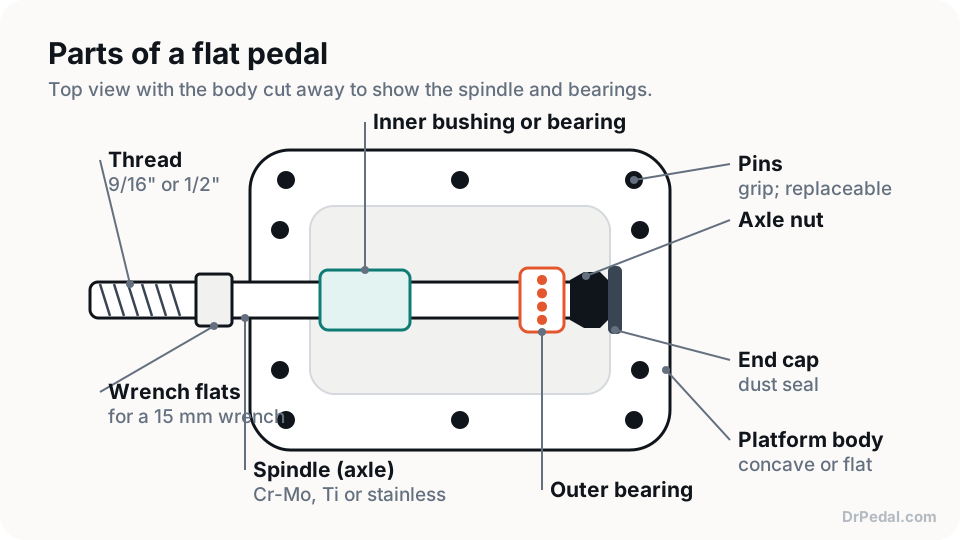
Replaceable pins are one of the clearest signs of a good flat pedal, because a bent or snapped pin is a cheap fix. See pedal pins and our flat pedals guide.
Cage pedal parts: cage plates, toe clip holes and reflectors
A cage pedal builds the platform from two metal plates, one at the front and one at the back, joined to a central body around the spindle. Your shoe rests on the plates’ edges, which are often serrated for grip.
Cage and quill pedals carry the fittings for traditional foot retention:
- Toe clip mounting holes: two holes in the front plate where a toe clip bolts on. They often double as the mounting for the front reflector.
- Strap slots: gaps at the inner and outer ends of the pedal that a toe strap runs through.
- Quill: on road quill pedals, a raised tab on the outer rear edge that stops the shoe sliding outward.
- Reflectors: front and rear reflectors, common on commuter pedals and rare on mountain-bike flats.
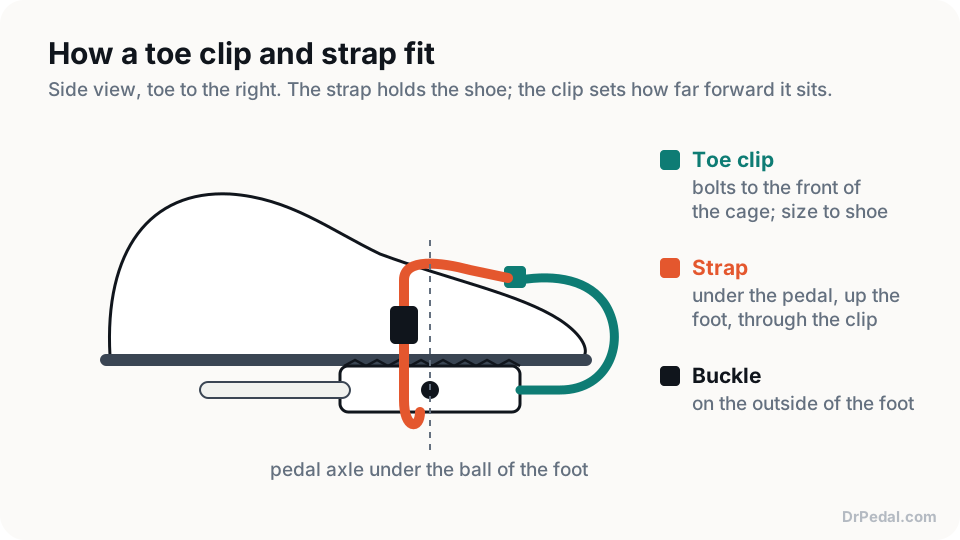
To fit clips, remove the front reflector and bolt the clip into the same holes. More on choosing them in cage pedals.
Clipless pedal parts: jaws, spring and tension screw
A clipless pedal swaps the platform for a mechanism that grabs a cleat on the shoe sole. The parts vary by system, but most share these:
- Front hook (front jaw): the fixed lip you push the toe of the cleat into first.
- Rear jaw (binding): the hinged part that snaps shut behind the cleat when you press down.
- Spring: holds the rear jaw closed. It sets how firmly the pedal holds and how much force it takes to twist out.
- Tension screw: a small adjuster, usually a hex bolt at the back of the mechanism, that changes spring preload. Shimano SPD and SPD-SL pedals have one.
- Body: a small platform around the mechanism on road and trail pedals, or almost nothing on minimalist mountain-bike pedals.
Not every system follows that layout. Crankbrothers pedals use spring-loaded wings with no tension screw, and Wahoo Speedplay puts the spring in the cleat rather than the pedal.
The cleat is the other half of the system. It bolts to the shoe: 2 bolts for SPD-style mountain and commuter shoes, 3 bolts for SPD-SL and Look road shoes, and 4 holes for Speedplay. Its shape sets the float, the free rotation before release, which our guide to cleat float covers. Compare complete systems on our clipless pedals page.
L and R markings
Every pedal is made for one side, and the markings save you from cross-threading a crank.
- Letters: look for L and R stamped on the spindle end, the wrench flats or the body.
- Grooves: some makers machine a groove or notches into the left spindle as a second marker.
- Thread direction: with the spindle pointing up, right-pedal threads rise to the right and left-pedal threads rise to the left.
- French pedals: older French pedals may be marked D (right) and G (left).
R goes on the chainring side. If a pedal will not spin in by hand, check the markings before using a wrench; our guide to which pedal is reverse threaded explains why.
Which pedal parts can you replace?
Many pedal parts can be replaced, so a worn pedal is not always a dead pedal.
| Part | Usually replaceable? | Notes |
|---|---|---|
| Pins | Yes | Match thread and length to the pedal |
| Cleats | Yes | Wear items; replace when release gets vague |
| Axle unit or spindle | Often | Ordered by pedal model |
| Bearings and bushings | Often | Rebuild kits from many makers |
| Dust cap | Often | Lost caps let dirt in fast |
| Reflectors and toe clips | Yes | Share the front mounting holes on cage pedals |
| Body | Rarely | A cracked body usually means a new pair |
If you are replacing more than two or three of these at once, compare the cost with a new pair before you start.
FAQ
What is the middle part of a bike pedal called?
The spindle, also called the axle. It is the steel shaft that threads into the crank arm; the pedal body spins around it on bearings or bushings.
What is the part of the pedal that screws into the crank called?
The threaded end of the spindle. On adult bikes it is 9/16" x 20 TPI; on one-piece cranks it is 1/2". See pedal thread sizes.
What is a pedal dust cap?
The cap on the outer end of the pedal body. It keeps dirt off the lock nut and bearings, and taking it off is the first step of a bearing service.
What is a pedal cage?
The frame of a cage pedal: two plates, front and back, joined to a central body around the spindle. The plates are what your shoe rests on, and the front plate usually has holes for a toe clip or reflector.
What are the parts of a clipless pedal?
A body with a front hook and a rear jaw, a spring that closes the jaw, and on many pedals a tension screw that sets how hard the spring holds. The cleat on your shoe is the other half of the system.
Can you replace parts of a bike pedal?
Often. Pins, cleats, reflectors, dust caps and on many pedals the whole axle unit or a rebuild kit are sold separately. A cracked body usually means a new pedal.