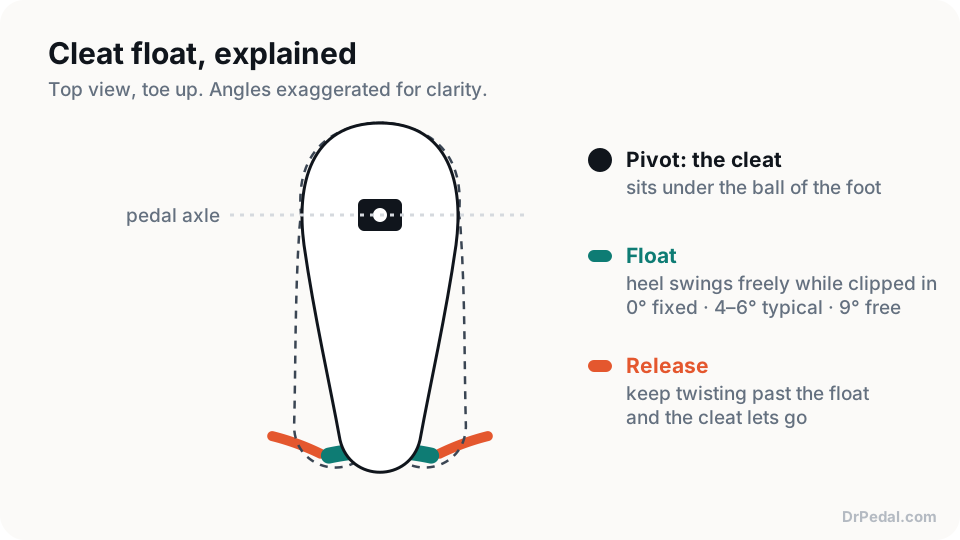
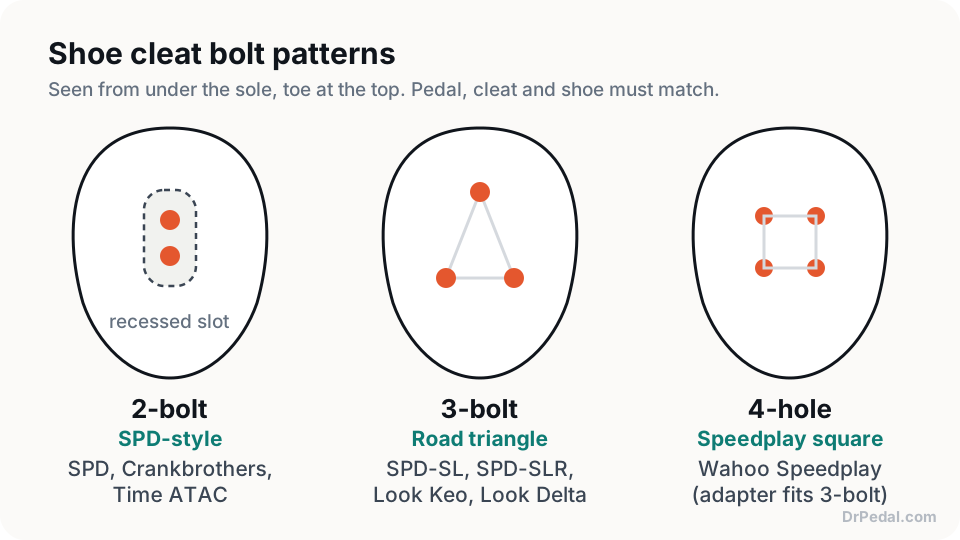
Cleat float is how far your heel can swing side to side while you are still clipped in, measured in degrees. Most riders do best with some float: 4° on Shimano SPD, 6° on yellow SPD-SL cleats, 4.5° on grey Look Keo cleats, or anywhere from 0° to 15° on Wahoo Speedplay. Float is not the same as release angle, which is how far you twist before the cleat lets go. On most systems you change float by swapping the cleat; on Speedplay you set it with two screws.
Independent & reader-supported. DrPedal doesn't sell anything. If you buy through our Amazon links we may earn a commission at no extra cost to you — as an Amazon Associate we earn from qualifying purchases. How we make money.
Cleats to change your float
Chosen on compatibility, specs and design — not sponsored. Amazon buttons open a search for the exact model.
Best for: Most riders on Shimano SPD-SL road pedals
The yellow cleat gives 6° of float, about 3° each way, and is the safe starting point unless a fitter tells you otherwise. Step down to the blue SM-SH12 (2°) or red SM-SH10 (0°) only if 6° feels vague.
Cleat float is free rotation: the number of degrees your shoe can pivot on the pedal, heel in or heel out, before the cleat starts to resist and then release. It is quoted as a total, so “6° of float” means a 6° arc, not 6° each way.
Your leg does not move in a perfect straight line. The knee tracks slightly in and out through each pedal stroke, and the foot rotates with it. Float lets that happen. A cleat with no float holds the foot at exactly the angle you bolted it, so any mismatch between that angle and your natural foot position goes straight into the knee.
Float is the arc your heel can swing through while clipped in. Twist past it and you reach the release point.
Cleat float vs release angle
Float and release angle are two different numbers. Float is the free zone where the shoe turns without resistance. Release angle is how far you must twist, measured from center, before the pedal lets the cleat go.
On most systems the sequence is the same: you rotate freely through the float, meet spring resistance at the edge, then keep twisting until you release. Crankbrothers publishes both figures, which makes the difference easy to see:
Standard cleat: 6° float, release at 15° or 20° depending on which foot each cleat is fitted to.
Easy Release cleat: 6° float (or 0°), release at 10°.
The float is identical, but the Easy Release cleat lets you out with less heel swing. On Shimano SPD and SPD-SL pedals, release also depends on the pedal’s spring tension, which you set with a screw on the pedal. On Speedplay, float and release are linked: twisting past the float range you set starts the release.
Cleat float by system
Each cleat system has its own float options, and none of the cleats cross over between systems.
System
Bolt pattern
Cleat options and float
Shimano SPD
2-bolt
SM-SH51 single release: 4°. SM-SH56 multi-release: 4°
CL-SL110 cleats; not compatible with SPD-SL pedals
Look Keo
3-bolt
Black 0°. Grey 4.5°. Red 9°
Look Delta
3-bolt
Black 0°. Grey 4.5°. Red 9° (different cleat from Keo)
Wahoo Speedplay
4-hole (3-hole adapter included)
Adjustable 0–15° on both Standard Tension (black) and Easy Tension (gray) cleats
Crankbrothers
2-bolt
Standard: 6°. Easy Release: 0° or 6°
A few details matter when you compare them:
Shimano’s blue SM-SH12 pivots near the front of the cleat, so the toe stays put while the heel moves a little. It suits riders who find 6° vague but do not want a fixed cleat.
SPD-SLR is Shimano’s newer road system (Ultegra PD-R8200 and Dura-Ace PD-R9300), with lower stack and easier engagement, per Shimano. Check Shimano’s documentation for its float rather than assuming the SPD-SL colors carry over.
Look Delta is the older Look system used by Peloton bikes. Delta and Keo cleats share the same color code but do not swap.
The colors are a quick visual check, but always confirm the system first. The same color can mean opposite things: red is 0° on Shimano SPD-SL but 9° on Look Keo. Our cleat compatibility chart lists every current option.
A fixed (0°) cleat holds the foot at one angle; a floating cleat lets it rotate within a set range.
Fixed cleats give the most locked-in feel. The foot cannot wander, which some sprinters and track riders like. The catch is that the cleat angle has to be right, because the knee has no way to correct for it. A fixed cleat that is a few degrees off can cause knee pain that a floating cleat would have hidden.
Floating cleats are more forgiving. Small errors in cleat rotation fall inside the float, and the knee moves on its own path. Too much float has its own downside: the foot can feel vague, and some riders find themselves working to hold the shoe still.
How much cleat float do you need?
Most riders should start with the middle option for their system and only move away from it for a reason.
Knee pain
Start with more float. Riders with sore knees, especially pain on the inside or outside of the knee, usually do better on yellow SPD-SL, red Look Keo or a generous Speedplay setting. Then check that the cleat rotation matches your natural foot angle, because float only helps if the center of its range sits where your foot wants to be. Persistent pain is a job for a bike fitter.
Cleat alignment
Set cleat rotation so your foot rests in the middle of the float when you pedal relaxed. If your heel sits hard against one end of the float all the time, the cleat is rotated wrong, not short of float. Alignment tools and wedges are in cleat fitment, and our cleat installation guide covers position step by step.
Racing and sprinting
Riders who sprint or race often prefer less float: blue SM-SH12 on Shimano or black on Look. Go to 0° only once your cleat position is dialed and your knees are happy on a low-float cleat first.
Commuting and first clipless pedals
Stick with the stock cleat. Shimano SPD’s 4° is plenty for most riders, and the SM-SH56 multi-release cleat makes emergency stops easier without changing float.
Adjustable float: Speedplay limit screws
Wahoo Speedplay is the only common system where you set float with a screwdriver. Each cleat has two float-limit screws, and the housing marks which one controls heel-in and which controls heel-out movement.
Start fully open. With both screws backed off, the cleat gives the full 15° of float.
Tighten to reduce float. Turning a screw in reduces heel movement in that direction only, so you can allow more heel-out than heel-in, or the reverse.
Both screws fully in removes float entirely.
Do not overdo it. Wahoo’s instructions say not to unscrew the limit screws out of their housing, and not to keep tightening once a screw touches the spring tip.
Match left and right unless you have a reason not to, and note the number of turns so you can copy it to new cleats.
Because the spring lives in the cleat, cleat choice also sets how hard entry and exit feel. The Wahoo Speedplay Easy Tension cleat keeps the same 0–15° float with a lighter spring.
How to change your cleat float
On every system except Speedplay, you change float by fitting a different cleat.
Confirm your system from the pedal or the old cleat: SPD, SPD-SL, Look Keo, Look Delta or Crankbrothers.
Pick the new float from the table above, and buy that color or version.
Mark the old cleat’s position by tracing round it on the sole with a fine marker, or take a photo.
Remove the old cleat and clean the sole and bolt threads.
Fit the new cleat in the same spot, then tighten the bolts evenly to the maker’s figure.
Clip in and out a few times on each side before you ride, and take a short ride before anything long.
On Crankbrothers, swapping the left and right cleats changes the release angle (15° or 20°), not the float. For an easier exit with the same 6° float, fit the Crankbrothers Easy Release cleat instead.
Signs your float is wrong
Your body usually tells you when float or cleat angle needs changing:
Knee pain on the inside or outside of the joint after rides.
Heel hitting the crank or chainstay, which suggests the cleat is rotated too far or the float lets the heel swing too far in.
Accidental unclipping when you pull hard, often from a heel already at the end of its float.
A “skating” feel, where the foot never settles. Try less float.
Uneven cleat wear on one side, a hint that your heel lives at one end of the range.
Worn cleats also feel loose and can mimic too much float. If your cleats are old, replace them before changing float; our guide to when to replace cleats shows what to look for.
FAQ
What does 6 degrees of float mean?
+
It is the total arc your heel can swing through while clipped in. On Shimano's yellow SM-SH11 cleat, that works out at about 3° each way from the position you set.
Is more cleat float better for your knees?
+
Often, yes. Float lets the knee and ankle find their natural path, so riders with knee pain usually start with more float. It is not a fix for a badly rotated cleat, though, so check alignment first.
What float do Shimano SPD cleats have?
+
Both standard SPD cleats have 4° of float: the black SM-SH51 (single release) and the silver SM-SH56 (multi-release). They differ in how you unclip, not in float.
Which Look Keo cleat has the most float?
+
The red Keo cleat, with 9°. Grey gives 4.5° and black is fixed at 0°. See the Look brand page for the pedals they fit.
Can I add float to a 0° cleat?
+
No. Fixed cleats have no float to adjust. Swap to a cleat with float, or on Speedplay back the float-limit screws out.
Does cleat float waste power?
+
Float lets the foot rotate, not slip downward, so the push still goes into the pedal. What changes is how locked-in the shoe feels. Riders who sprint hard often prefer less float for that reason, not because float costs watts.