Clipless pedals lock a cleat on the bottom of your shoe to the pedal, and you release by twisting your heel outward. Pick the system first: a 2-bolt Shimano SPD pedal such as the Shimano PD-M520 suits commuting, gravel, touring and mountain biking because the shoes are walkable and the pedal is double-sided, while a 3-bolt road system (Shimano SPD-SL or Look Keo) suits road riding. Pedal, cleat and shoe must all use the same system, and almost every adult bike takes a 9/16" pedal thread.
Independent & reader-supported. DrPedal doesn't sell anything. If you buy through our Amazon links we may earn a commission at no extra cost to you — as an Amazon Associate we earn from qualifying purchases. How we make money.
Top picks
Chosen from current models on manufacturer specs, compatibility and design — not sponsored placements. Amazon buttons open a search for the exact model.
Best for: Commuting, touring, gravel, spin bikes and first-time clipless riders
The default first clipless pedal: double-sided SPD entry, adjustable tension and a recessed 2-bolt cleat you can walk on. It comes with single-release SM-SH51 cleats; multi-release SM-SH56 cleats make getting out easier.
Best for: Road riders buying new pedals and cleats together who want the lowest stack
Part of Shimano's newer SPD-SLR road system: lower stack and easier engagement, per Shimano. It ships with CL-SL110 cleats, and major retailers state SPD-SLR cleats don't fit SPD-SL pedals, so treat it as a new system.
Look's entry-level Keo pedal uses the same 3-bolt Keo cleats as the premium Blade models, so you can upgrade pedals later without changing cleats or cleat position. Pick black (0°), grey (4.5°) or red (9°) cleats to set the float.
Best for: Road riders already on Keo cleats who want a lighter, lower pedal
A carbon-bodied Keo pedal that gets its retention from a carbon blade spring instead of a coil spring, with ceramic bearings. It is the 2024 replacement for the Keo Blade Carbon Ceramic and uses the same Keo cleats as every other Keo pedal.
Best for: Road riders with knee issues or who want double-sided road entry
Speedplay's lollipop design puts the retention spring in the cleat, so the pedal is double-sided and float adjusts from 0° to 15°. The 4-hole cleat comes with a 3-hole adapter for standard road shoes, and the Comp ships with Easy Tension cleats. The Zero, Nano and Powrlink Zero power meter use the same cleats.
Best for: Cyclocross, muddy gravel and XC riders who value quick entry
Four-sided entry and a minimal open mechanism that has very little to pack with mud. There is no tension screw: the release angle is 15° or 20° depending on which foot the Standard cleat goes on, with 6° float. See the Eggbeater 1 page.
Best for: Gravel, XC and trail riders who want a bit more support than an Eggbeater
The Eggbeater mechanism with a small platform around it, which supports the shoe better while keeping four-sided entry and the same 2-bolt Crankbrothers cleats. See the Candy 1 page.
Best for: Trail and enduro riders who want a slim clipless pedal with a platform
HT's current trail/enduro clipless pedal puts double-sided entry inside a slim platform (the T2T is the titanium-spindle version). It bolts to any 2-bolt shoe but runs HT's own cleats: X1 (4° float) or X1F (8°), not Shimano SPD cleats.
Clipless pedals vs clip pedals: what the names mean
Clipless pedals and “clip pedals” are usually the same thing: pedals that lock to a cleat bolted under your shoe. They are “clip-less” because they replaced toe clips and straps in the 1980s, even though riders say they “clip in”.
“Clip pedals” can mean any of these:
Clipless pedals (this page). A cleat on your shoe snaps into a spring-loaded mechanism. You need compatible shoes.
Toe clip pedals. A cage on the front of the pedal, usually with a strap, holds the toe of any shoe. See toe clips and straps.
Magnetic pedals. A magnet holds a steel plate bolted where a cleat would go. See magnetic pedals.
How clipless pedals work
A clipless pedal has a spring-loaded catch that grabs a cleat on your sole. You hook the front of the cleat into the pedal and press down until the rear catch clicks over it.
To release, you rotate your heel outward past the release angle. Before that point most cleats allow a few degrees of free rotation, called float, so your knees can follow their natural path. How hard the pedal holds you is the release tension.
Clipless pedal systems compared
The cleat must match the pedal, and the cleat’s bolt pattern must match the shoe. Cleats do not cross between systems.
System
Shoe pattern
Entry
Float
Walking
Typical use
Shimano SPD
2-bolt
Double-sided (most models)
4° (SM-SH51 or SM-SH56)
Easy, cleat is recessed
MTB, gravel, commuting, touring, spin bikes
Shimano SPD-SL
3-bolt
Single-sided
0°, 2° or 6° (red, blue, yellow)
Awkward
Road
Shimano SPD-SLR
3-bolt
Single-sided
Set by cleat (CL-SL110 supplied)
Awkward
Road (newest system)
Look Keo
3-bolt
Single-sided
0°, 4.5° or 9° (black, grey, red)
Awkward
Road
Wahoo Speedplay
4-hole (3-hole adapter included)
Double-sided
0–15° adjustable
Awkward, use covers
Road
Crankbrothers
2-bolt
Four-sided
6° (0° premium option)
Easy
MTB, gravel, cyclocross
Time ATAC
2-bolt
Double-sided
Angular and lateral float
Easy
MTB, gravel
HT Components
2-bolt
Double-sided
4° (X1) or 8° (X1F)
Easy
XC, trail, enduro, DH
Shimano SPD (2-bolt)
SPD is the most widely used clipless system and the safest default for anything that is not a road race bike. The small metal cleat sits in a recessed channel in the sole, so you can walk normally.
Shimano offers two cleats, both with 4° float. The black SM-SH51 is single-release: you twist out sideways. The silver SM-SH56 is multi-release: it also lets go if you pull up and twist, which many beginners and commuters prefer. Many other brands, including Xpedo and Look’s X-Track range, make pedals that accept SPD-style cleats.
Shimano SPD-SL and the new SPD-SLR (3-bolt)
SPD-SL is Shimano’s road system: a large plastic cleat on a 3-bolt shoe and a wide, single-sided pedal body. Cleat color sets the float: red SM-SH10 is 0°, blue SM-SH12 is 2°, and yellow SM-SH11 is 6°. Shimano’s 105 PD-R7000, Ultegra PD-R8000 and Dura-Ace PD-R9100 all use them.
SPD-SLR is Shimano’s newest road system, used by the Ultegra PD-R8200 and Dura-Ace PD-R9300 and supplied with CL-SL110 cleats. Shimano describes it as having a lower stack and easier engagement than SPD-SL. SPD-SLR cleats still bolt to standard 3-bolt shoes, but major retailers such as Rose Bikes state they are not compatible with SPD-SL pedals, so don’t mix old and new parts.
Look Keo (3-bolt)
Look Keo uses the same 3-bolt shoe pattern as SPD-SL but its own cleats. Float is set by cleat color: black 0°, grey 4.5°, red 9°. Every Keo pedal, from the Keo Classic 3 to the Keo Blade Ceramic and the older Keo Blade Carbon Ceramic, takes the same cleats. See the Look brand page for the range.
Wahoo Speedplay (4-hole)
Speedplay flips the usual layout: the pedal is a small double-sided “lollipop” and the spring sits in the cleat. You get double-sided road entry and float you can set from 0° to 15° with screws on the cleat. A 3-hole adapter plate is included for standard road shoes. Choose Standard Tension or Easy Tension cleats to change how hard it holds. The cleats are large and not made for walking, so most riders use cleat covers.
Crankbrothers (2-bolt)
Crankbrothers pedals (Eggbeater, Candy, Mallet) use a 2-bolt brass cleat and a wire-spring mechanism you can enter from four sides. There is no tension screw. The Standard cleat gives 6° float and a 15° or 20° release angle depending on which foot you fit it to; the Easy Release cleat releases at 10° and comes in 0° or 6° float. Crankbrothers and Shimano cleats bolt to the same shoes but are not interchangeable.
Time ATAC (2-bolt)
Time’s ATAC pedals use a 2-bolt cleat with built-in angular and lateral float, which some riders with knee trouble prefer. SRAM now owns Time’s pedal business, and availability of individual ATAC models has been patchy, so none is a top pick here. If you already ride ATAC cleats, stay with them.
How to choose clipless pedals
Choose by bike and shoe first, then by features.
Match the pedal to your riding
Commuting, touring, spin classes: Shimano SPD, ideally the PD-M520 with SM-SH56 cleats.
Gravel and cyclocross: SPD or Crankbrothers, for quick re-entry on climbs and in mud.
Cross-country MTB: a light double-sided pedal such as the Shimano XT PD-M8100 or Crankbrothers Candy.
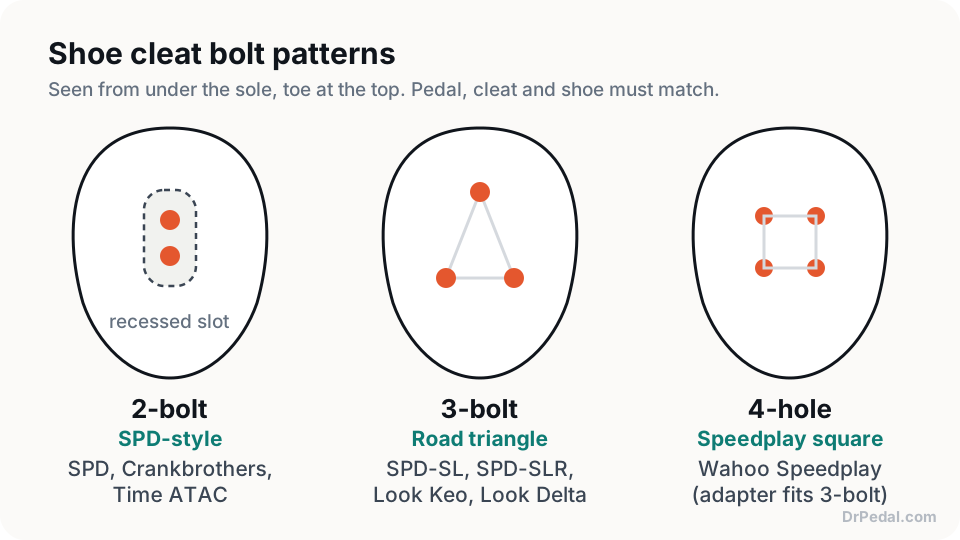
2-bolt (SPD-style): mountain bike, gravel, touring and casual cycling shoes. Works with Shimano SPD, Crankbrothers, Time ATAC, HT, Xpedo and other SPD-style pedals.
3-bolt (Look-style): road shoes. Works with SPD-SL, SPD-SLR and Look Keo, and with Speedplay via its adapter.
4-hole: Speedplay’s own pattern, found on a small number of road shoes. Speedplay cleats bolt straight on without the adapter.
A few shoes take both 2-bolt and 3-bolt cleats, but most do not, so check the sole first. The cleats guide covers which cleat fits which shoe.
Float
Float is how far your heel can rotate before the pedal starts to release. Zero float locks your foot in place, which some racers like but which can strain knees if the cleat is slightly off. Most riders are comfortable with 4–6°: Shimano SPD 4°, Shimano yellow road cleats 6°, Crankbrothers 6°, Look grey 4.5°.
If you have knee pain, try more float first (Look red 9°, HT X1F 8°, or Speedplay opened up) and get a bike fit if it persists.
Release tension
Lower tension makes it easier to clip out, which is what you want for your first weeks. Shimano SPD and SPD-SL pedals use a tension screw on each pedal; set both sides the same. Crankbrothers has no adjustment, so you choose the release angle with the cleat. Speedplay tension comes from the cleat type, and Look Blade pedals from the blade spring fitted.
Single-sided vs double-sided entry
Double-sided (or four-sided) pedals let you clip in without looking, which matters at traffic lights, on climbs and in technical terrain. Single-sided road pedals are weighted to hang tail-down, so you slide the cleat forward to hook the front lip, then press down; it takes a few rides to learn. They trade that convenience for a larger, lower engagement face. More options are on our double-sided clipless pedals page.
Platform and shoe stiffness
The smaller the pedal body, the more your sole has to do. Stiff race shoes work on tiny pedals like the Eggbeater; flexible commuter or trail shoes feel better on a platform such as the Candy, Mallet, Shimano PD-M530 or HT T2.
Thread size and fit
Nearly all clipless pedals use a 9/16” x 20 TPI thread, which fits two- and three-piece cranks on adult bikes. A 1/2” thread is only for one-piece cranks on some kids’, BMX and cruiser bikes, and clipless pedals are rarely made in that size. The left pedal is reverse threaded; it tightens counterclockwise. See which pedal is reverse threaded before you start.
HT clipless pedals: models, cleats and fit
HT clipless pedals are slim, double-sided pedals from HT Components for cross-country, trail, enduro and downhill. They bolt to any 2-bolt shoe, but they are designed around HT’s own cleats, not Shimano’s.
Current models to look for:
HT T2 / T2T: trail and enduro pedal with a slim platform around the mechanism; the T2T has a titanium spindle. The older T1 is a previous generation.
HT M2 / M2T: light cross-country race pedal with a minimal body; the M2T has a titanium spindle. The M1 is an older XC model.
HT X3: larger clipless platform for downhill and gravity riding. The X1 and X2 are earlier downhill models you may still see.
Cleats: the X1 cleat (4° float) comes with most HT pedals, and the X1F (8° float) gives more freedom for riders who move around on the bike or have sensitive knees. HT also makes other variants, including a separate cleat for its smaller SX pedals, so check that a cleat kit lists your pedal model.
SPD compatibility: some retailers describe HT pedals as SPD compatible, meaning they fit SPD shoes. HT’s X1-series cleats are the ones listed for its clipless pedals, so use those. If you want to use your existing Shimano cleats, buy a Shimano or other SPD-style pedal instead.
Can you use mountain bike clipless pedals on a road bike?
Yes. Road pedals spread load over a bigger 3-bolt cleat, but 2-bolt SPD pedals work on any road bike and let you walk normally, so many tourers, commuters and long-distance riders use them. The reverse rarely makes sense: road cleats are slippery to walk on and wear quickly off-road.
How to clip in and out
Clipping in takes one motion once you have practiced. Unclipping should become automatic before you ride in traffic.
Clip in: put the front of the cleat into the front of the mechanism, then push down with your heel until it clicks. On a road pedal, hook the front lip first.
Check: pull up gently. The shoe should stay put but rotate slightly within the float.
Clip out: rotate your heel straight outward, away from the bike. Pulling up will not release a single-release cleat.
Unclip early: release one foot well before you stop. Most riders always unclip the same side.
First-ride tips for new clipless riders
Most new riders tip over once at a standstill, so practice where it does not matter.
Set release tension to its lowest setting, and use multi-release SM-SH56 cleats if you ride SPD.
Practice on a trainer, or on grass leaning against a wall, until clipping out is automatic.
Ride a quiet loop before traffic, and unclip a few seconds before every stop.
Shift to an easier gear before you stop so restarting is easy.
Raise tension a quarter-turn at a time only if you pull out unintentionally.
Installing clipless pedals and setting up cleats
Clean and grease the threads, start each pedal by hand, then tighten. Most pedals use a 15 mm pedal wrench, a hex key in the back of the spindle, or both; see pedal tools. Shimano specifies 35–55 N·m for its pedals. Some riders fit a thin pedal washer to protect the crank face.
For cleats, three rules get most riders close:
Fore-aft: ball of the foot over, or just in front of, the pedal spindle.
Rotation: copy your natural foot angle (sit on a table, let your feet hang and look).
Side to side: start centered; move the cleat if your knee tracks in or out or your heel hits the crank.
Tighten the bolts to the torque in the cleat instructions and recheck after the first ride.
Are clip pedals and clipless pedals the same thing?
+
Usually, yes. "Clip pedals" and "clip in pedals" are everyday names for clipless pedals, which lock to a cleat on your shoe. The name "clipless" means they replaced toe clips; if you want a cage and strap that works with any shoe, see toe clips and straps.
What are HT clipless pedals and do they take SPD cleats?
+
HT Components makes slim double-sided clipless pedals such as the T2 (trail/enduro) and M2 (cross-country). They mount on any 2-bolt SPD-style shoe, but they are designed for HT's own X1-series cleats (X1 at 4° float, X1F at 8°), so fit HT cleats rather than Shimano SPD cleats.
Which clipless pedals are best for beginners?
+
A double-sided Shimano SPD pedal such as the PD-M520 with multi-release SM-SH56 cleats and the tension turned down. You can clip in on either side, walk normally in recessed 2-bolt shoes, and get out by twisting or pulling up at an angle.
Do clipless pedals come with cleats?
+
Most do: Shimano SPD pedals usually include SM-SH51 cleats, Shimano road pedals yellow cleats, and Crankbrothers and Speedplay their own. Replacements and other float options are in the cleats guide.
Can I use road clipless pedals with mountain bike shoes?
+
Usually not. Road pedals (SPD-SL, Look Keo) need a 3-bolt shoe, and most mountain bike shoes only have a 2-bolt channel. Go the other way instead: 2-bolt SPD pedals work on a road bike, and many road and gravel riders use them so they can walk.
Are clipless pedals worth it?
+
For regular rides, yes. The cleat keeps your foot in the same place every stroke and stops it bouncing off on rough ground. For short trips in everyday shoes, a clip-one-side, flat-the-other pedal is often more practical.
Will clipless pedals fit my bike?
+
Almost certainly, if it has a two- or three-piece crank: those use a 9/16" x 20 TPI pedal thread, and every clipless pedal here is 9/16". Bikes with one-piece cranks use 1/2" threads. Remember the left pedal is reverse threaded; see which pedal is reverse threaded.
How often should I replace cleats?
+
When release becomes vague or unpredictable, the cleat rocks on the pedal, or the wear marks on road cleats are gone. Road cleats wear fastest because you walk on them; cleat covers slow that down.