Toe clip pedals are cage or quill-style pedals with two bolt holes in the front plate for a toe clip, plus slots for a toe strap that cinches over your shoe. The classic setup is a pedal like the MKS Sylvan Touring with MKS steel toe clips and a nylon or leather strap; if your pedals have no clip holes, or you want an easier exit in regular shoes, a diagonal strap such as Power Grips is the simpler fix. Size clips so the ball of your foot sits over the pedal spindle, not by shoe size alone.
Independent & reader-supported. DrPedal doesn't sell anything. If you buy through our Amazon links we may earn a commission at no extra cost to you — as an Amazon Associate we earn from qualifying purchases. How we make money.
Top picks
Chosen from current models on manufacturer specs, compatibility and design — not sponsored placements. Amazon buttons open a search for the exact model.
A double-sided quill pedal with hand-adjusted cup-and-cone bearings that MKS builds to take toe clips and straps. Retailer listings agree on a 94 x 63 mm platform and 391 g per pair.
Best for: Big shoes, boots and riders whose toes hit a large clip
Chrome-plated steel clips from the Japanese maker of the Sylvan pedals. XL is the largest size most Western retailers carry (MKS's own size code is LL), so it is the one to pick for bulky shoes.
Best for: Road and touring bikes, replacement clips
Zefal still makes the Christophe clip in chromed steel, in two sizes, and supplies the mounting hardware. Straps are sold separately; Zefal pairs it with its Christophe leather or XL fabric straps.
A short clip that stops your foot sliding forward but has no strap, so you can pull your foot out backwards at any moment. A good first step for riders nervous about being held to the pedal.
Best for: Classic road, track and fixed-gear builds
The Spirits version is leather with a stainless buckle; the Sports version sandwiches an anti-stretch nylon layer between suede leather and is NJS-certified as a double strap. Both come in single and double versions.
One diagonal strap per pedal replaces the clip and strap. You slide in with your toe angled in, straighten your foot to tighten it, and roll your heel out to leave.
Best for: Fixed-gear and BMX-style platform pedals
A pair of wide double-band straps with a Velcro closure, made for platform pedals rather than toe clips. Hard to find at the moment, so check the alternatives on its page.
Plain nylon toe straps with a steel buckle, made to thread through a toe clip and a cage pedal. A budget replacement that will not stretch when wet the way old leather can.
Start with your pedals. Toe clips only bolt onto pedals with clip holes; strap-only systems need a metal cage or suitable slots; flat pedals without either need a different solution. Then size the clip to your shoes, not just your foot.
Pedal compatibility
A pedal accepts toe clips if its front plate has two holes for the clip bolts, usually the same holes that hold the front reflector. The strap then passes through slots at the inner and outer ends of the pedal. Classic quill and cage pedals, such as the MKS Sylvan series and the MKS GR-9, are made for this.
Power Grips need a metal cage pedal that accepts toe clips and straps, according to the maker. Wellgo’s W8 and similar Velcro straps are aimed at platform pedals with openings for the strap ends.
Toe clip size
Clip size sets how far forward your foot sits. Too small and the spindle ends up under your toes with your toes pressed into the clip; too large and your foot slides forward until the spindle is under the arch. The full method is in the sizing section below.
Leather straps like MKS Fit Alpha look right on classic bikes and soften with use; the nylon-cored Fit Alpha Sports resists stretch.
Diagonal straps like Power Grips replace clip and strap with one band.
Velcro double straps like the Wellgo W8 wrap a wide band over a platform pedal.
Shoes and riding style
Toe clips work with almost any shoe that has a reasonably stiff sole and no deep tread lugs. Thick-toed sneakers and boots need a larger clip or the Power Grips XL. Commuters who stop often usually prefer half clips or Power Grips; track riders and fixed-gear riders usually want full clips with tight straps.
Thread size, if you are buying pedals too
Most adult bikes take pedals with a 9/16” x 20 TPI thread; 1/2” pedals are for one-piece cranks on some kids’, BMX and cruiser bikes. The left pedal is reverse threaded, so it tightens counterclockwise; see which pedal is reverse threaded.
Toe clips vs straps vs clipless pedals
Toe clips hold your foot in place and let you pull up on the pedal, but you exit by sliding back rather than twisting. Clipless pedals lock a cleat to the pedal and release with a heel twist. Strap-only systems sit between the two.
Toe clips and straps
Power Grips / diagonal straps
Velcro platform straps
Clipless
Shoes
Most shoes; slim toes easiest
Almost any shoe; XL for boots
Almost any shoe
Cycling shoes with cleats
Pedal needed
Pedal with clip holes and strap slots
Metal cage pedal
Platform with strap openings
Matching clipless pedal
How you exit
Slide foot back (loosen strap first)
Roll heel outward and back
Pull foot back
Twist heel outward
Hold
Firm when strap is tight
Moderate, self-tightening
Moderate
Firmest, most precise
Best for
Classic, touring, track
Commuting, casual riding
Fixed gear, urban
Road, MTB, gravel, racing
If you want the efficiency of a locked-in foot and are happy to wear cycling shoes, compare clipless pedals. If you want to stay in your everyday shoes, clips or straps are the better answer.
How to size toe clips
Size a toe clip so the ball of your foot sits over the pedal spindle with a little clearance between your shoe tip and the clip. Use your shoe size only to narrow the choice.
Put your usual riding shoe on the pedal with the ball of your foot directly over the spindle.
Measure how far the toe of the shoe sticks out beyond the front of the pedal, where the clip bolts on.
Choose the clip whose reach is a few millimeters longer than that, so your toes do not touch the clip.
If you ride in bulky sneakers, hiking shoes or winter boots, measure in those; they often need one size up.
Size labels are not standard between brands. MKS steel clips are sold as M, L and XL outside Japan (the Japanese range runs SS to LL), the MKS Cage Clip comes in M and L, and Zefal sells the Christophe in S/M and L/XL. Retailer shoe-size charts for the same MKS clip disagree by up to a full size, so trust the measurement over the chart.
If you are between sizes, go larger: a strap can hold a foot slightly back in a big clip, but nothing fixes a clip that crushes your toes. The MKS steel toe clips in XL are the usual answer for large feet; the MKS stainless cage clips in Large suit medium-to-large shoes on bikes that stay outside.
Which pedals accept toe clips?
Pedals with a front cage plate drilled for clip bolts accept toe clips; most modern flat pedals do not.
Quill and cage pedals: made for clips. The MKS Sylvan Touring, Sylvan Road and Sylvan Track and the MKS GR-9 are all sold as toe-clip compatible. See cage pedals and MKS track pedals.
Commuter resin and alloy pedals: many have two holes behind a removable front reflector. Look for them before you buy clips.
Modern pinned flat pedals: usually not drilled. Retailers list the MKS Lambda, for example, as not toe-clip compatible. Use a strap system instead, or switch to a pedal that is drilled.
Clipless pedals: no. Use cleats instead.
The MKS Allways is a middle case: a concave flat that retailers list as compatible with Velcro-style pedal straps. Listings disagree on whether it takes a toe clip, so check the pedal body for front clip holes before buying clips for it.
How to install toe clips and straps
Fitting clips takes 10 minutes with a screwdriver and a small wrench. Do it with the bike on a stand or leaned against a wall.
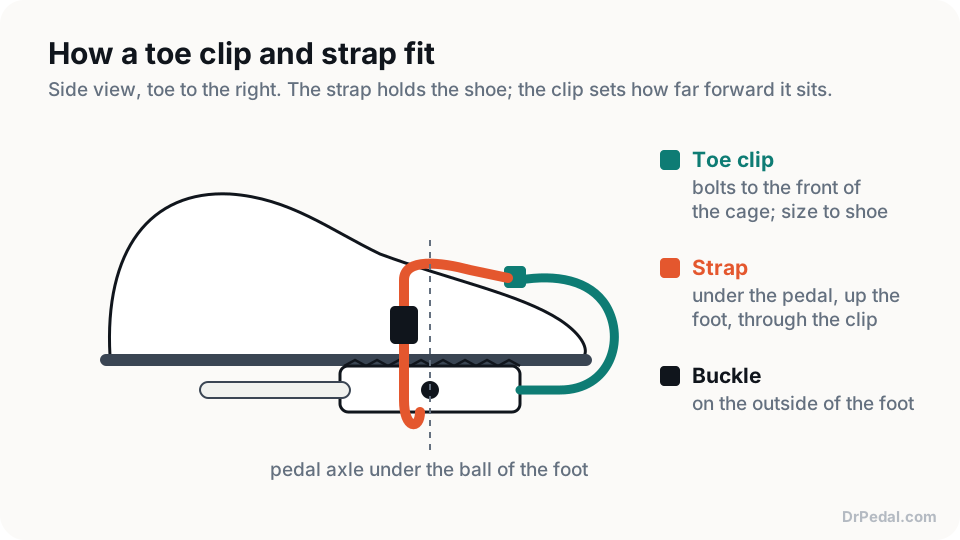
A toe clip bolts to the front of the cage; the strap runs under the pedal, up through the clip and over the shoe.
Remove the front reflector if the pedal has one; its screws use the clip holes.
Bolt the clip to the outside of the front plate with the clip’s curve rising up and back over the pedal. Fit the nut behind the plate and tighten firmly; a loose clip bolt rattles and wears the holes.
Thread the strap through the slot at the outer end of the pedal, up through the loop at the top of the clip, and through the slot at the inner end, so it forms a loop over the pedal.
Put a half twist in the strap where it passes through the pedal body. The twist grips the cage and stops the strap sliding sideways.
Place the buckle on the outside of the pedal, just below your foot, so it does not rub the crank and you can reach the tab.
Check toe overlap. Clips push your foot forward; on small frames, turn the bars and make sure the clip clears the front tire or fender.
Power Grips mount differently: one strap runs diagonally across each pedal, held by a micro-adjustable bracket you set with a 4mm Allen key. Follow the diagram in the box for which corner holes to use on the left and right pedals.
Single vs double toe straps
A single strap is enough for commuting, touring and most road riding. Double straps are a track and fixed-gear setup for sprint loads.
Single strap: one strap per foot, through both ends of the pedal and the clip loop. Loosen it for traffic and pull it tight for climbs.
Double strap: a second band, or a two-buckle strap, adds hold across the foot. The pedal needs two sets of strap slots; check before buying.
MKS makes its Fit Alpha straps in both single and double versions. The Sports double strap is NJS-certified for keirin racing.
Getting in and out of toe clips safely
The main safety rule: your foot only comes out backwards, so keep the strap loose until you are moving and loosen it before you stop.
Getting in: start with one foot already in the clip. Push off, then tap the back of the empty pedal with your toe to flip it over so the clip faces up, and slide your foot in. Reach down and tug the strap tail if you want it tighter.
Getting out: loosen the strap by flicking the buckle tab up, then pull your foot straight back. You cannot twist out sideways as with clipless pedals. Practice on grass or an empty lot until you do it without looking.
In traffic: many commuters ride with the strap permanently loose, which keeps the foot positioned but lets it slide out freely. Half clips remove the risk altogether.
Power Grips: angle your toe inward to slide into the strap, straighten your foot to tighten it, and roll your heel outward and back to exit.
Toe clips for track and fixed-gear bikes
Track and fixed-gear riders use toe clips because the pedals never stop turning, and a foot thrown off at speed is dangerous. A single-sided quill pedal, steel clips and a tight leather strap remain the standard track setup.
The MKS Sylvan Track is single-sided and meant to be used with clips and straps; listings agree on 343 g per pair and a 9/16” thread. Browse the full range of MKS track pedals. Pair them with NJS-certified MKS Fit Alpha Sports straps if you want the keirin look, or doubled straps for sprint efforts.
Riders who skid-stop and do tricks on platforms often prefer Velcro straps such as the Wellgo W8 or Hold Fast, which wrap a wider band over the foot.
Toe clips and straps for commuting in regular shoes
Commuters get most of the benefit from the simplest setups.
Half clips: stop your foot sliding forward on wet pedals with no strap to release. The MKS Cage Clip Half is made to be ridden strapless.
Power Grips: work with sneakers, work shoes and, in the XL size, winter boots. Leaving the foot is a natural heel-out roll.
Full clips with a loose strap: best for longer rides where you want to pull up on climbs; tighten the strap when the road opens up.
Stainless clips: chrome-plated steel can rust where the plating chips; stainless avoids that on bikes parked outside.
A grippy double-sided commuter pedal plus half clips or Power Grips covers most city riders. If you would rather add retention to modern flats, look at strap-only systems.
Strap-only systems for flat and platform pedals
If your pedals have no clip holes, a strap-only system is the answer.
Diagonal straps (Power Grips, Restrap Diagonal): one band across the pedal that tightens as you straighten your foot. Power Grips specify metal cage pedals.
Horizontal straps (Restrap Horizontal): pass through openings on either side of the pedal and work with any footwear.
Velcro foot-retention straps (Wellgo W8, Hold Fast): a wide band over the forefoot for fixed-gear and BMX-style platform pedals.
Before buying, look at your pedal body: you need slots, holes or a cage edge where the strap can anchor without rubbing on the crank.
Care and wear
Toe straps wear out before clips do. Replace a strap when the stitching frays, the leather cracks or the buckle no longer bites.
Check clip bolts every few months; they loosen and wear oval holes in the pedal plate.
Treat leather straps with leather conditioner and let them dry naturally after rain.
Bent clips can be gently reshaped by hand, but a cracked clip should be replaced.
If you sell or store the bike, slacken the straps so they do not take a set.
Not for performance: clipless pedals hold the foot more precisely and release with a heel twist. Toe clips win when you want to ride in any shoe, need a cheap retention upgrade or are building a classic or track bike.
What size toe clips do I need?
+
Choose the clip that puts the ball of your foot over the pedal spindle with a few millimeters of room in front of your toes. Shoe size is only a starting point: brands use different size letters, and bulky sneakers or boots often need one size up.
Can you put toe clips on any pedal?
+
No. The pedal needs two holes in its front plate to bolt the clip on, and slots for the strap. Quill and cage pedals have them; most modern pinned flat pedals, including the MKS Lambda, do not.
Do you need straps with toe clips?
+
Full clips are designed to be used with a strap; without one the clip only stops your foot sliding forward. If you want to ride strapless, buy half clips, which are shaped for exactly that.
Are toe clips dangerous?
+
They are safe once practiced, but a tight strap stops you putting a foot down quickly. Ride with the strap loose in traffic, pull your foot straight back to exit, and practice on grass before riding busy roads.
Are Power Grips better than toe clips?
+
Power Grips are easier to get in and out of and work with a wider range of shoes, and they need no clip holes on a metal cage pedal. Toe clips with a tight strap hold the foot more firmly, which is why track riders still use them.
What is the difference between single and double toe straps?
+
A single strap runs once around the foot through the pedal and clip. Double straps add a second band for sprint and track loads and need a pedal with two sets of strap slots.
Do toe clips work on fixed-gear bikes?
+
Yes. Retention matters more on a fixed gear because the pedals keep turning, so many riders use steel clips and tight leather straps on MKS track pedals.