A cleat tool holds your shoe against a template so you can set cleat fore-aft position, rotation and stance width, then copy the same setup to the other shoe. The Ergon TP1 comes in versions for Shimano SPD and SPD-SL, Look Keo, Crankbrothers, SRAM/Time and Speedplay; the Crankbrothers Cleat Tool covers Crankbrothers, SPD and Time ATAC 2-bolt cleats. For foot tilt, add cleat wedges such as BikeFit's, at about 1° each.
Independent & reader-supported. DrPedal doesn't sell anything. If you buy through our Amazon links we may earn a commission at no extra cost to you — as an Amazon Associate we earn from qualifying purchases. How we make money.
Top picks
Chosen from current models on manufacturer specs, compatibility and design — not sponsored placements. Amazon buttons open a search for the exact model.
#1Best road cleat tool
Ergon TP1 Cleat Tool (SPD-SL or Look Keo version)
by Ergon
Best for: Road riders setting up 3-bolt cleats or copying a fit to new shoes
A folding polypropylene template that holds both shoes so you can set fore-aft, stance width (Q-factor) and foot angle and check that left and right are mirror images. Buy the version for your cleat: TP1 SPD SL for Shimano road cleats, TP1 Keo for Look Keo. It is not Look Delta compatible.
Ergon TP1 Cleat Tool (SPD, Crankbrothers or SRAM/Time version)
by Ergon
Best for: Mountain, gravel and commuter riders with 2-bolt cleats
The same TP1 idea with templates for Shimano 2-bolt SPD, Crankbrothers and SRAM/Time cleats. Ergon includes a handbook on foot ergonomics and cleat placement, which is useful if you are doing your own setup.
Type
Alignment template
Fits
Shimano SPD, Crankbrothers or SRAM/Time (separate versions)
Best for: Crankbrothers riders setting cleats and choosing shim thickness
A compact tool with molded guides for lateral, fore-aft and rotational position, which also gives you leverage so the cleat does not twist while you tighten. It includes four tread-depth gauges for picking the right shim, and works with Crankbrothers, SPD and Time ATAC cleats.
Best for: 2-bolt cleat riders whose feet tilt in or out
A wedge that sits between a 2-bolt SPD-style cleat and the sole to correct forefoot tilt (varus or valgus). BikeFit rates each wedge at about 1° and sells them individually so you can stack to the angle you need.
Best for: Road riders on Look Keo or Shimano SPD-SL cleats
BikeFit's 1° wedge for 3-bolt road cleats. Its install guide lists Look Keo and Delta, Shimano SPD-SL and Campagnolo cleats, so one wedge type covers most road systems.
A cleat tool turns cleat setup into measurement. The shoe, with the cleat loosely bolted on, sits in a template that shows where the pedal axle falls, which way the cleat points and how far it sits from center. Adjust, tighten, then set the other shoe to the same marks.
It fixes three common problems: left and right cleats that don’t match, cleats that rotate while you tighten them, and losing your position when you change shoes.
How to choose a cleat tool
Compatibility: buy the right version
Cleat tools are system-specific because cleats are. The Ergon TP1 is sold in separate versions for Shimano SPD (2-bolt), Shimano SPD-SL, Look Keo, Crankbrothers, SRAM/Time and Speedplay. None of them fit Look Delta. The Crankbrothers Cleat Tool covers Crankbrothers, Shimano SPD and Time ATAC 2-bolt cleats. If you are not sure which cleat you have, check the cleat compatibility chart.
What it adjusts
Both tools handle fore-aft and rotation. The Ergon TP1 adds stance width (Q-factor) and is designed to check both shoes at once. The Crankbrothers tool adds tread-depth gauges, which matters on Crankbrothers pedals because the shoe tread must clear the pedal body.
Tool vs bike fit
A tool repeats a position; it does not tell you what the right position is. With knee, hip or foot pain, get a bike fit first, then use a tool to record it.
Crankbrothers cleat tools and setup
The Crankbrothers Cleat Tool is the one to have if you ride Eggbeater, Candy, Mallet or Double Shot pedals. Crankbrothers cleats sit on the same 2-bolt slot as Shimano cleats, but its pedals have wider bodies that can touch the tread of lugged shoes. The tool’s four tread-depth gauges show whether you need a shim under the cleat; the shims themselves are covered in cleat hardware.
The tool also gives you leverage while tightening, since cleats can rotate as the bolts bite. For which Crankbrothers cleat to fit, see the Easy Release cleat page and the Crankbrothers brand page.
Ergon cleat tool versions
Each Ergon TP1 holds a pair of shoes on a folding polypropylene base marked for fore-aft, stance width and foot angle, and comes with a handbook on cleat placement. Versions: TP1 SPD (Shimano 2-bolt), TP1 SPD SL (Shimano road), TP1 Keo (Look Keo, not Delta), TP1 Crankbrothers, TP1 SRAM/Time and TP1 Speedplay.
The Speedplay version is for first-generation Speedplay cleats only and does not fit Speedplay Walkable or current Wahoo cleats. Retailers have started listing a separate Wahoo Speedplay version, so check the name before buying.
How to position cleats with a tool
Mark the ball of your foot: the bony bumps behind the big toe and little toe, on the side of the shoe.
Fit the cleats loosely, just snug enough to hold.
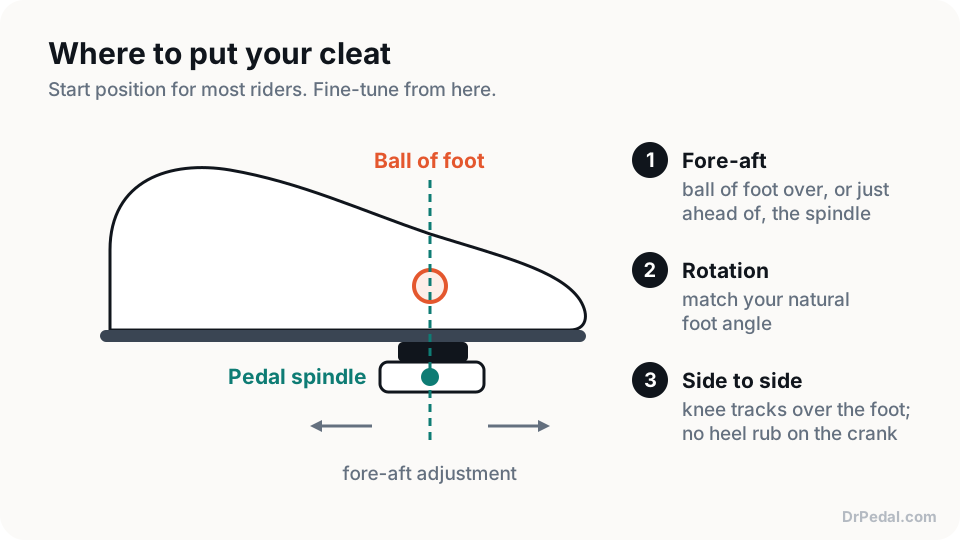
Set fore-aft: the tool’s axle mark on your ball-of-foot line, or a few millimeters behind.
Set rotation to the angle your foot naturally points (sit on a table and let your feet hang).
Set stance width so your knees track straight over your feet.
Tighten in steps with the cleat held in the tool, to the torque in your cleat instructions.
Copy to the other shoe and recheck both after the first ride.
How to position cleats without a tool
A ruler and a marker get you close.
The usual starting point: ball of the foot over the pedal spindle, then fine-tune rotation and stance.
Mark the ball of each foot as above and draw a line across the sole between the marks.
Place the cleat so the pedal axle sits on, or just behind, that line, pointing along your natural foot angle.
Measure from the heel and sole edge to the cleat, then copy those measurements to the other shoe.
Ride on a trainer. If a heel presses against the float limit, adjust rotation; if a knee moves in or out, adjust stance width.
Wedges tilt the cleat to suit a forefoot that naturally rolls in (varus) or out (valgus). Many riders’ forefeet are not level, which is why wedges are a standard bike-fit tool.
BikeFit SPD wedges fit 2-bolt cleats at about 1° each. BikeFit’s instructions say the arrow points to the front and the wedge may overhang at the back, but should not stick out in front of the cleat.
3-hole wedges from BikeFit or Specialized fit Look Keo and Shimano SPD-SL cleats at 1° each.
Stacking adds angle, but each wedge lifts the cleat too, so you may need longer bolts; see cleat hardware.
Check each foot separately; they often differ.
Fitters use BikeFit’s forefoot measuring device to estimate how many wedges you need. If you are guessing, start with one and change one thing at a time. See the BikeFit brand page.
Yes. The Crankbrothers Cleat Tool has guides for lateral, fore-aft and rotational position, gives leverage so the cleat does not twist while tightening, and includes tread-depth gauges for choosing a shim. It also works with Shimano SPD and Time ATAC cleats.
Which Ergon cleat tool do I need?
+
The TP1 version that matches your cleat: SPD (Shimano 2-bolt), SPD SL (Shimano road), Keo (Look), Crankbrothers, SRAM/Time or Speedplay. The older Speedplay version is for first-generation cleats and does not fit Speedplay Walkable or current Wahoo cleats.
Can I set cleats without a tool?
+
Yes. Mark the ball of your foot on the shoe, line the cleat up with it, set rotation to your natural foot angle and match the second shoe by measuring. A tool just makes it faster and more repeatable.
Do I need cleat wedges?
+
Only if your forefoot tilts noticeably in or out, or a fitter recommends them. Signs include knees that move in or out at the top of the stroke and pressure on one edge of the foot.