Toe clips vs clipless: clipless pedals hold your foot most firmly and precisely, release with a heel twist and need cycling shoes with cleats. Toe clips and straps work with most everyday shoes and still suit classic, touring and fixed-gear bikes, but you exit by sliding your foot back. Strap systems such as Power Grips or Velcro foot straps are the easiest to get in and out of in normal shoes. Commuters in everyday shoes usually do best with straps; riders happy to wear cycling shoes do best with clipless.
Independent & reader-supported. DrPedal doesn't sell anything. If you buy through our Amazon links we may earn a commission at no extra cost to you — as an Amazon Associate we earn from qualifying purchases. How we make money.
A starting point for each system
Chosen on compatibility, specs and design — not sponsored. Amazon buttons open a search for the exact model.
Best for: Touring and commuting with clips, straps or Power Grips
A double-sided quill pedal drilled for toe clips, with slots for a strap. Its metal cage also suits Power Grips, so it works with whichever retention you settle on.
Best for: Fixed-gear, track and classic builds; big shoes
Chrome-plated steel clips, NJS approved for keirin, that hold their shape under a tight strap. XL suits large or bulky shoes; smaller sizes are sold for smaller feet. Add a toe strap per pedal.
One diagonal strap per pedal replaces clip and strap. Slide in with your toe angled in, straighten your foot to tighten it, and roll your heel out to leave. Power Grips specify metal cage pedals.
Double-sided SPD entry, adjustable tension and a recessed 2-bolt cleat you can walk on. Add multi-release SM-SH56 cleats if you are coming from clips or straps.
The three systems trade hold against freedom. Clipless holds firmest but needs special shoes; straps hold least but work with almost anything; toe clips sit between them.
Toe clips + straps
Strap systems (Power Grips, Velcro straps)
Clipless pedals
How the foot is held
Clip stops the foot sliding forward; strap cinches over the shoe
One band over the foot
Cleat locked in a spring binding
Hold
Firm with the strap tight, loose with it slack
Moderate
Firmest and most precise
Shoes
Most shoes; slim toes easiest
Almost any shoe
Cycling shoes with cleats
Pedal needed
Cage or quill pedal with clip holes and strap slots
Metal cage (Power Grips) or platform with strap openings
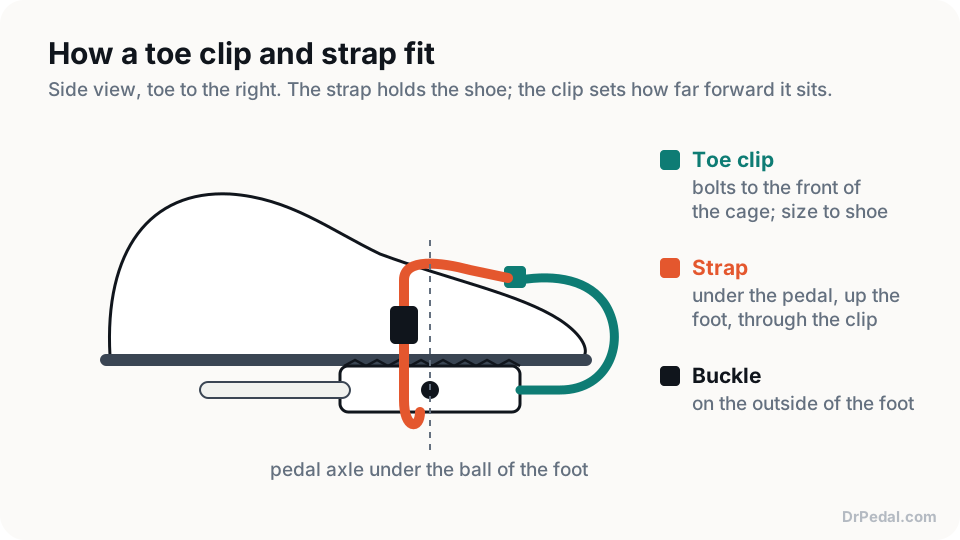
A toe clip is a curved steel or plastic cage bolted to the front plate of the pedal. A strap runs through slots in the pedal body, up through a loop on the clip and over your shoe. The clip stops your foot sliding forward, and the strap controls how firmly your foot is held.
A toe clip bolts to the front of a cage pedal; the strap runs through the pedal and over the shoe.
With the strap loose, clips simply locate your foot. Pulled tight, they hold it firmly enough to pull up on the pedal. Clips come in sizes, and the right one puts the ball of your foot over the spindle; MKS steel toe clips in XL are the usual answer for big feet and bulky shoes.
Half clips are a strapless variation. They stop your foot sliding forward and nothing more, so you can always pull out backwards.
How strap systems work
Strap systems drop the clip and hold your foot with a band alone.
Diagonal straps (Power Grips): one strap runs diagonally across the pedal. Angle your toe inward to slide in, straighten your foot to tighten the strap across it, and roll your heel outward to release. The standard set suits most shoes, and the Power Grips XL set is longer for boots and wide shoes.
Velcro foot straps (Hold Fast-style): a wide hook-and-loop band anchored to the sides of a platform pedal, popular on fixed-gear and BMX-style bikes. You slide your foot in and pull back to exit.
Both work with sneakers and work shoes, which is their whole appeal. Neither needs clip holes, but each needs somewhere to anchor: Power Grips specify a metal cage pedal, while Velcro straps need openings at the pedal edges.
How clipless pedals work
A clipless pedal has a spring-loaded binding that grips a cleat bolted to the sole of a cycling shoe. You step down to clip in and twist your heel outward to release. The name means “without toe clips,” which is why it sounds backwards.
Clipless needs a matching shoe: 2-bolt SPD-style for mountain, gravel and commuting, or 3-bolt for road systems. See SPD vs SPD-SL vs Look Keo for the differences and our clipless pedals guide for options.
Retention: which holds your foot best?
Clipless holds best. The cleat fixes your foot’s fore-aft and side-to-side position, and it stays locked until you twist out. You can pull up hard, sprint out of the saddle and ride over rough ground without your foot moving.
Toe clips with a tight strap come next. The hold can be very firm, which is why track riders used them for decades, but the foot can still creep in the clip and the shoe sole matters.
Strap systems hold least. They keep your foot on the pedal and located, and let you pull up a little, but a hard yank can lift your foot out. For commuting, that is often exactly what you want.
Shoe freedom
Straps win on shoe freedom, clipless loses.
Strap systems: almost any shoe, including boots with the right strap size.
Toe clips: most shoes, but thick toes and deep treads can be hard to slide in and out. Smooth, slim soles work best.
Clipless: cycling shoes only. Walkable SPD shoes make this less of a burden than it sounds, but you still change shoes for every ride.
Safety: getting out in a hurry
The safest system is the one you can exit without thinking. Each has a different exit motion, and each must be practiced.
Toe clips: your foot only comes out backwards, and a tight strap can stop it coming out at all. Keep the strap loose in traffic and loosen it before you stop.
Power Grips: a heel roll releases the foot, a motion similar to clipless but gentler. Velcro straps release when you pull back.
Clipless: release with a heel twist. The motion becomes automatic within a few weeks; before that, the slow topple at a standstill is common. Multi-release SPD cleats and low tension help, and our clip in and out guide has practice drills.
Fixed-gear and track bikes
Foot retention matters more on a fixed gear because the pedals keep turning whenever the bike moves. A foot that bounces off at speed can’t be put back while the cranks are spinning.
Track and keirin-style builds: single-sided MKS track pedals, steel toe clips and tight leather straps, sometimes doubled for sprint loads. NJS-approved parts such as MKS steel clips are the classic choice.
Street fixed gear: many riders prefer wide Velcro straps. They hold the foot for skid stops and backpedaling and work with skate shoes.
Long-distance fixed riding: SPD clipless is common, for the same reasons road riders choose clipless.
Whatever you choose on a fixed gear, practice getting in with the cranks moving. You can’t coast while you find the pedal.
Commuting in everyday shoes
For commuting, the simplest system usually wins.
Power Grips or Velcro straps: quick to enter, release with a natural movement and work with work shoes.
Half clips: no strap to manage at every red light.
Full clips with a loose strap: good for longer commutes where you want to pull up on climbs.
Clipless: worth it on long commutes if you already change shoes at work. A hybrid pedal with a flat side covers both. See best pedals for hybrid and commuter bikes.
Which pedals does each system need?
Check your pedals before buying any retention.
Toe clips: a cage or quill pedal with two holes in the front plate and slots for a strap. Most modern pinned flats are not drilled. See cage pedals.
Power Grips: a metal cage pedal that accepts toe clips and straps, according to the maker.
Velcro straps: a platform pedal with openings at the edges for the strap ends.
Clipless: a clipless pedal matched to your cleats; clips and straps do not fit.
How to choose
Do you want to keep riding in everyday shoes? Choose straps for easy exits or toe clips for a firmer hold.
Is it a track or classic bike? Toe clips and leather straps on a cage or track pedal.
Nervous about being held at all? Half clips or Power Grips, or read flat vs clipless pedals.
FAQ
Are toe clips safe?
+
Yes, once practiced, but a tight strap stops you putting a foot down quickly because your foot only comes out backwards. Ride with the strap loose in traffic, loosen it before you stop, and practice exits on grass first.
Are Power Grips better than clipless pedals?
+
For riding in normal shoes, often yes: they are quick to enter, release with a heel roll and need no cleats. Clipless pedals hold more firmly and precisely, which matters on long, fast rides. See the Power Grips standard set.
Can you use toe clips on clipless pedals?
+
No. Clipless pedals have no front plate to bolt a clip to. Toe clips need a cage or quill pedal with clip holes; see cage pedals.
Do toe clips make you faster?
+
They keep your foot in the right spot and stop it bouncing off at high cadence, which helps more than any claimed pulling power. Research comparing flat and clipless pedals at steady effort found no significant efficiency difference, so treat retention as control first. See flat vs clipless pedals.
What do fixed-gear riders use: clips, straps or clipless?
+
All three. Classic track builds use steel toe clips and tight leather straps on MKS track pedals. Street fixed-gear riders often prefer wide Velcro straps for skid stops, and many road-going fixed riders use SPD.
Can I put straps on flat pedals?
+
Sometimes. Velcro foot straps are made for platform pedals with openings for the strap ends, but Power Grips specify metal cage pedals. Check that your pedal has slots or holes before buying.