The two pedal thread sizes
Bike pedals come in two thread sizes today, and which one you need depends on the crank, not the bike’s size or price.
| Thread | Outside diameter | Crank type | Typical bikes |
|---|---|---|---|
| 9/16” x 20 TPI | About 14.3 mm | Two-piece and three-piece cranks | Road, mountain, hybrid, gravel, e-bikes, BMX race bikes, better kids’ bikes |
| 1/2” x 20 TPI | About 12.7 mm | One-piece (Ashtabula) cranks | Many budget kids’ bikes, cruisers, older and department-store BMX bikes |
Both sizes have 20 threads per inch, so the only difference is diameter. That 1/16” gap is small enough to fool you by eye and big enough that the wrong pedal will either not go in or not hold.
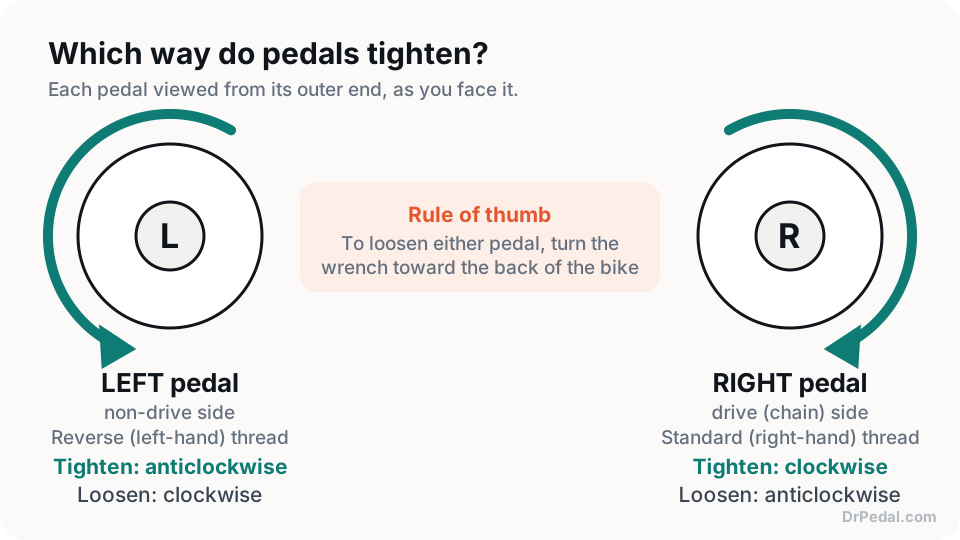
Thread direction works the same way on both sizes. The right (drive-side) pedal has a normal thread. The left pedal is reverse threaded: it tightens anticlockwise and loosens clockwise.
One-piece vs two- and three-piece cranks
The crank tells you the pedal thread size before you touch a tool.
One-piece (Ashtabula) crank. Both crank arms and the axle are a single piece of forged steel, bent into an S-shape that runs through a large bottom bracket shell. You will see big cups and a cone nut on the drive side instead of crank bolts. One-piece cranks take 1/2” pedals.
Three-piece crank. Two separate crank arms bolt onto a bottom bracket spindle, with a crank bolt or cap on each side. This is the classic adult-bike layout, and it takes 9/16” pedals.
Two-piece crank. One arm is fixed to the spindle and the other clamps on, as on most modern road and mountain cranks. These also take 9/16” pedals.
If you are unsure, look for a seam between the crank arm and the axle. No seam and no crank bolts usually means a one-piece crank.
How to tell which pedal thread you have
You can confirm the size in a few minutes without special tools.
- Check the crank type as described above. This is right for the vast majority of bikes.
- Read the markings. Some pedals and cranks stamp the thread size near the spindle or on the arm. Pedal packaging and listings almost always state it.
- Measure the pedal thread. Remove a pedal and measure across the outside of the threads with calipers: about 14.3 mm means 9/16”, about 12.7 mm means 1/2”.
- Check the bike’s spec sheet if you have the model name. Kids’ bikes in particular vary within the same brand.
- Test-fit by hand only. A pedal of the right size and side spins in easily for several turns. If it binds after a turn or two, stop. Forcing it is how crank threads get stripped.
If your measurement lands close to 14 mm on an old bike, read the French thread section below before buying.
Kids’ bikes and BMX
Kids’ bikes are where thread mix-ups happen most, because both sizes are common.
- Budget kids’ bikes and cruisers often use one-piece cranks and need 1/2” pedals. Many 1/2” pedals are sold specifically as replacements for these bikes.
- BMX race bikes and better kids’ bikes use two- or three-piece cranks and take 9/16” pedals. Quality junior pedals are often made in 9/16” only. The Answer BMX MPH Junior, for example, is listed in 9/16” only, so it will not fit a one-piece crank.
- Older BMX bikes may have either. Check the crank, not the bike’s age.
When you shop for small pedals, filter by thread first and platform size second. Our platform pedals guide notes the thread for every pick.
Can you adapt between 9/16” and 1/2”?
Not in the direction most people want.
- 9/16” pedals on a 1/2” crank: no adapter can do this. The pedal thread is larger than the hole in the crank, so there is nothing for an adapter to screw into. Buy 1/2” pedals, or replace the crank.
- 1/2” pedals on a 9/16” crank: the pedal is too small to grip the threads. It will feel loose and can pull out. Buy 9/16” pedals.
- Repair bushings and inserts exist, but they repair a damaged 9/16” hole and give you a 9/16” thread back. They are not size converters.
A shop can sometimes convert a one-piece-crank bike to a three-piece crank with a different bottom bracket. On a budget kids’ bike that usually costs more than the bike is worth, so 1/2” pedals are the practical answer.
French and other legacy pedal threads
Some older bikes made for the French market used a 14 x 1.25 mm pedal thread. Most French bikes sold in the US used the standard 9/16” thread, so this mainly affects bikes bought in France or Europe decades ago.
The two threads are close enough to cause trouble. A French pedal will start into a 9/16” crank and then bind, and forcing it damages the crank. French-thread pedals are often marked D (droite, right) and G (gauche, left) instead of R and L.
The usual fix is to have a shop run standard 9/16” x 20 taps through the French cranks, so they take normal pedals from then on. French-thread replacement pedals are rare, so re-tapping is normally easier than hunting for them.
Stripped pedal threads: helicoils and inserts
A stripped pedal thread can often be repaired. Most damage comes from cross-threading, fitting a pedal on the wrong side, or riding with a loose pedal.
Light damage. A shop can chase the threads with a pedal tap. Park Tool sells pedal taps in both 1/2” and 9/16”, with left- and right-hand threads, so the left crank gets a left-hand tap.
Stripped aluminum cranks. The fix is a threaded insert. Two common systems:
- Park Tool pedal bushing kit: the crank is tapped out to 5/8” x 20 TPI and a bushing is fitted that has a standard 9/16” x 20 TPI thread inside. Park Tool specifies a strong thread locker, has the bushing sit slightly recessed, and does not recommend the repair for hollow or carbon crank arms.
- Unior Crank Saver: a reaming tap cuts out the damaged thread and sizes the hole for an insert, which is fixed with thread locker and gives a standard 9/16” pedal thread.
Coil-type (helicoil-style) inserts are another option some shops use. Whichever system you choose, it is a precise job: the tap has to go in straight, so this is best done by a shop with the right kit.
Carbon and hollow cranks. Ask the crank maker. The usual answer is a new crank arm.
Stripped 1/2” one-piece cranks. The repair inserts on the market are made for 9/16” holes. A stripped one-piece crank is normally replaced.
Fitting pedals the right way
Most thread damage happens during fitting, and it is easy to avoid.
- Match the sides. R goes on the chainring side, L on the left.
- Clean and grease the threads. Use anti-seize on titanium spindles.
- Start by hand, turning toward the front of the bike. It should spin in freely for several turns.
- Tighten with a pedal wrench or hex key. Shimano specifies 35–55 N·m for its pedals; use the pedal maker’s figure if it differs.
- Re-check after the first ride.
The full method, including the “turn toward the back to loosen” rule, is in which pedal is reverse threaded. Pedal wrenches and hex tools are compared in our pedal tools guide.
Buying pedals by thread size
Almost every pedal sold for adult bikes is 9/16”, so on most bikes you can skip the worry. Thread size matters when you buy for:
- A kids’ bike, cruiser or budget BMX: check for a one-piece crank and buy 1/2” if so.
- A vintage French bike: check for 14 x 1.25 mm before ordering.
- Replacement spindles or axle units: they must match your pedal model as well as the thread. See pedal spindles.
If a listing does not state the thread, assume nothing. Clipless pedals, flat pedals and platform pedals for adult bikes are 9/16” as standard, but budget pedals for kids’ bikes may be either size.
FAQ
Are all bike pedals the same thread size?
No. Most are 9/16" x 20 TPI, but bikes with one-piece cranks need 1/2" x 20 TPI pedals. Some old French bikes used a 14 x 1.25 mm thread.
What size are BMX pedal threads?
Most modern BMX bikes have three-piece cranks and take 9/16" pedals. Older and budget BMX bikes with one-piece cranks take 1/2". Check the crank before you buy.
How do I know if my pedals are 9/16 or 1/2?
Look at the crank: a one-piece steel crank means 1/2", separate crank arms mean 9/16". To confirm, measure the outside of the pedal thread with calipers: about 14.3 mm is 9/16", about 12.7 mm is 1/2".
Can I put 9/16 pedals on a 1/2 crank?
No. The 9/16" thread is bigger than the 1/2" hole, and no adapter can fix that. Buy 1/2" pedals, or replace the crank.
What does 20 TPI mean on a pedal?
Twenty threads per inch, the thread pitch. Both common pedal sizes use 20 TPI; only the diameter differs.
Are bike pedal threads metric?
The two common sizes are inch sizes. In metric terms, 9/16" is about 14.3 mm across. The old French 14 x 1.25 mm thread is a different, slightly smaller thread, not a metric name for 9/16".