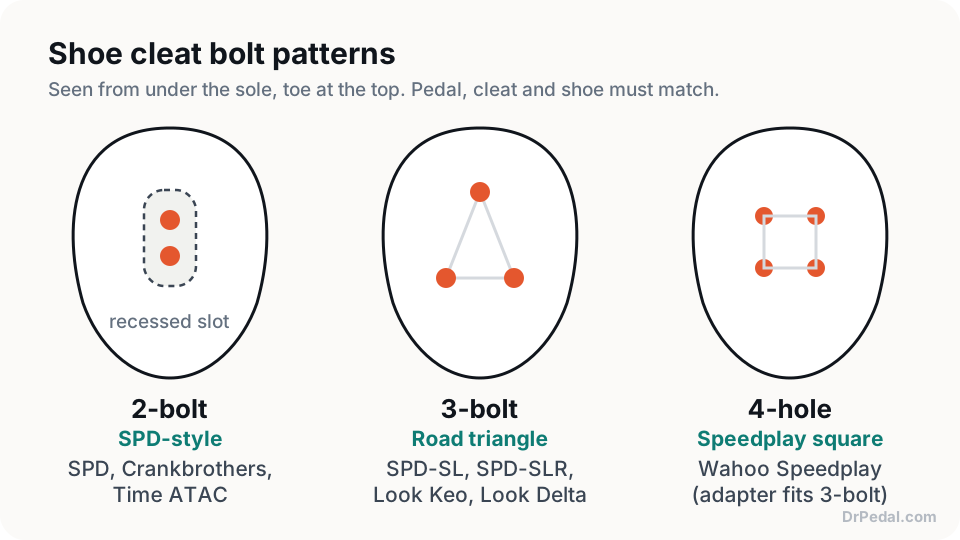
Peloton pedals on the Bike and Bike+ take 3-bolt Look Delta cleats, not SPD and not Look Keo. Many other spin bikes use 2-bolt SPD cleats, often on a pedal with SPD on one side and a toe cage on the other. Peloton's pedals use the standard 9/16" thread, so you can swap them for SPD pedals with a pedal wrench; just remember the left pedal is reverse threaded.
Independent & reader-supported. DrPedal doesn't sell anything. If you buy through our Amazon links we may earn a commission at no extra cost to you — as an Amazon Associate we earn from qualifying purchases. How we make money.
Cleats and pedals worth considering
Chosen on compatibility, specs and design — not sponsored. Amazon buttons open a search for the exact model.
Best for: Peloton Bike and Bike+ riders with 3-bolt shoes
Look's own Delta cleats fit the stock Peloton pedals and bolt to any 3-bolt road or indoor shoe. Pick the float by color: black 0°, gray 4.5° or red 9°. Check the pack says Delta, not Keo.
Best for: Riders who want walkable SPD shoes on a Peloton or spin bike
A plain double-sided SPD pedal with adjustable tension and a standard 9/16" thread, so the same shoes work on the spin bike, a gravel bike and a commuter. Single-release SM-SH51 cleats come in the box.
Best for: Spin-class riders and anyone new to clipping in
Multi-release SPD cleats with 4° float: twist out either way, or lift and twist. They fit any SPD pedal, including the SPD side of most spin bike pedals.
The Peloton Bike and Bike+ come with clip-in pedals for Look Delta cleats. Delta is Look’s older 3-bolt road system, which came before Keo and lives on mainly on indoor bikes.
Peloton’s support pages say its cleats attach to shoes with a 3-hole pattern and describe a standard 9/16” pedal connection. Peloton also sells replacement Delta-compatible pedals listed for both the Bike and Bike+, and says installation needs only a pedal wrench.
So with the stock pedals you need two things: a 3-bolt shoe and Delta cleats. A 2-bolt SPD shoe will not clip in until you change the pedals.
Look Delta vs SPD
Look Delta is a road-style system with a big plastic cleat; SPD is a 2-bolt system with a small metal cleat that sits inside a walkable sole.
Look Delta
Shimano SPD
Shoe bolt pattern
3-bolt (road-style)
2-bolt (recessed channel)
Cleat
Large plastic cleat
Small metal cleat
Float
Black 0°, gray 4.5°, red 9°
4° (SM-SH51 and SM-SH56)
Entry
Single-sided
Double-sided on most pedals
Release options
Heel twist
Single- or multi-release
Walking
Awkward and slippery on hard floors
Normal; the cleat is recessed
Where you find it
Peloton Bike and Bike+, some studio bikes
Many home and studio spin bikes, MTB, gravel, commuting
Shoes
Road shoes, Peloton shoes, 3-bolt indoor shoes
MTB, gravel, touring and 2-bolt indoor shoes
Look Delta uses the same 3-bolt triangle as SPD-SL and Keo; SPD uses the 2-bolt channel.
Indoors, neither system is “better”. Delta gives a large, stable platform and works with shoes set up for Peloton. SPD lets you walk around the house, use the same shoes on gym bikes and an outdoor gravel or mountain bike, and choose multi-release cleats. Pick the one that matches the shoes you want to wear.
Look Delta vs Look Keo
Delta and Keo share a brand and a 3-bolt shoe pattern, but the cleats are different shapes and do not interchange. This is the most common Peloton buying mistake, because many listings just say “Look cleats” and mean Keo.
Adding to the confusion, the float colors match in both systems: black 0°, gray 4.5°, red 9°. Check that the pack says Delta. If you already own Keo road shoes, they are fine; just bolt Delta cleats to them. Our SPD vs SPD-SL vs Look Keo guide covers the outdoor systems.
Which shoes and cleats to use
Start from the pedals on the bike you ride most.
Peloton with stock pedals: any 3-bolt cycling shoe with Delta cleats. Red 9° is the most forgiving for knees, gray 4.5° sits in the middle, and black 0° holds your foot fixed, so only use it with carefully set cleats.
Spin bike with SPD pedals: any 2-bolt shoe with SM-SH51 or SM-SH56 cleats. Indoor-cycling and mountain bike shoes both work.
Shoes drilled for both: some indoor-cycling shoes take 2-bolt and 3-bolt cleats, which helps if you ride a Peloton at home and SPD bikes at the gym. Check the sole.
Sneakers: you need a toe cage or a flat side; clip-in pedals alone are not safe in normal shoes.
Set the cleats up with the ball of your foot over the pedal spindle; the method is in how to install clipless pedals and cleats. Many cleat-alignment templates are made for Keo or SPD-SL rather than Delta, so check before buying one from cleat fitment.
Other spin bikes: SPD and dual-sided pedals
Many home and studio spin bikes outside Peloton use SPD-compatible pedals, often with a toe cage on the other side. BowFlex’s C6, for example, ships with dual-sided pedals: SPD clips on one side and toe cages for athletic shoes on the other.
Gym and studio bikes vary more. Some have SPD and toe-cage pedals, and some have multi-system pedals that take both SPD and Delta cleats. If you ride at a gym or studio, ask which cleat its bikes use before you buy shoes. SPD cleats in a recessed shoe are the safest bet, because you can also walk to the bike in them.
Should you swap your Peloton pedals to SPD?
Swap if you want to walk in your cycling shoes, already own SPD shoes from mountain biking, gravel or spin classes, or want multi-release cleats. Keep Delta if you already have 3-bolt road shoes, several people share the bike in Peloton shoes, or you like the larger platform.
Swap options
Double-sided SPD pedal: such as the Shimano PD-M520. Clip in from either side; SPD shoes only. More options in double-sided clipless pedals.
SPD and toe-cage pedals: the spin-bike standard. Clip in on one side, or ride in sneakers in the cage on the other. Check that the pair has a 9/16” thread and is marked L and R.
Delta and SPD combination pedals: one side takes Delta, the other SPD, which suits a household with both shoe types. These come mostly from third-party makers, so check the thread, bearings and how the cleat mechanism adjusts.
Toe-cage adapters for Delta pedals: a cage that clips into the stock pedal like a cleat. No tools needed, but check the adapter is made for Delta.
SPD and flat hybrid pedals: see hybrid pedals. Without a cage, sneakers can slip off a flat side at high cadence, so a toe cage is the safer indoor choice.
How to swap pedals on a Peloton or spin bike
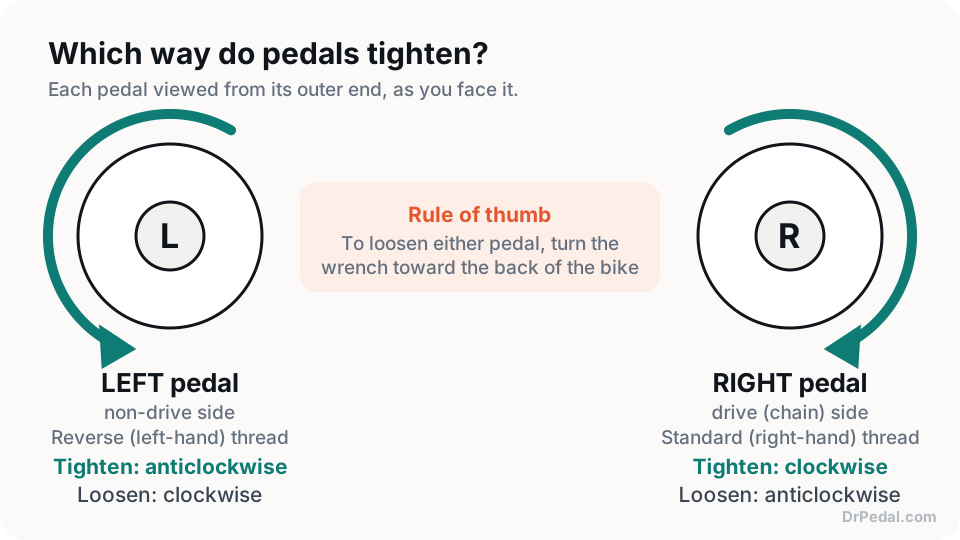
Swapping pedals on a spin bike is the same job as on a road bike: the right pedal has a normal thread and the left pedal is reverse threaded.
On both sides, turn the wrench toward the back of the bike to loosen and toward the front to tighten.
You need a 15 mm pedal wrench (or a hex key if your new pedals have a socket instead of flats), grease and a rag. See pedal tools.
Stop the cranks turning. Turn the resistance right up, or use the bike’s brake, so the crank holds still while you push on the wrench.
Set the crank horizontal with the pedal you are removing toward the front.
Remove the right pedal by turning the wrench toward the back of the bike: counterclockwise.
Remove the left pedal, again turning toward the back of the bike. Because it is reverse threaded, that is clockwise.
Clean and lightly grease the crank threads and the new pedal threads.
Start each new pedal by hand: R clockwise into the right crank, L counterclockwise into the left. Both should spin in easily for several turns. If one binds, back it out and restart straight.
Tighten firmly. Shimano specifies 35–55 N·m for its pedals; for other brands, use the figure in the instructions.
Recheck both pedals after the first few rides.
If a pedal will not budge, double-check the direction first; most “seized” left pedals are being turned the wrong way. Penetrating oil and a longer wrench handle the rest; see how to remove bike pedals and which pedal is reverse threaded.
Older Peloton bikes: the 2020 pedal recall
In October 2020, Peloton and the US Consumer Product Safety Commission recalled PR70P clip-in pedals on Peloton bikes sold between July 2013 and May 2016, because they could break unexpectedly and cause leg cuts. Peloton offered free replacements.
Affected pedals have “Peloton” molded into the body, with an orange Peloton logo and the word “Peloton” printed on top of the cleat binding. Pedals with white lettering only were not part of the recall. If you buy a used early Peloton that still has PR70P pedals, replace them before you ride.
Caring for indoor pedals and cleats
Sweat is the main enemy indoors. Wipe the pedals and cleats after hard sessions, check the cleat bolts every few weeks, and replace cleats when they look worn or start releasing on their own. Walking on hard floors wears plastic Delta cleats quickly, so change shoes off the bike where you can.
FAQ
Can I use SPD cleats on a Peloton?
+
Not with the stock pedals, which only take Look Delta cleats. Swap the pedals for any 9/16" SPD pedal, or for a combination pedal with Delta on one side and SPD on the other.
Do Look Keo cleats work on a Peloton?
+
No. Keo and Delta are both Look 3-bolt systems, but the cleats are different shapes and Keo cleats will not clip into a Delta pedal. Your Keo road shoes are fine; just bolt Delta cleats to them.
What thread size are Peloton pedals?
+
Peloton describes a standard 9/16" pedal connection, the same as almost every adult bike. The left pedal is reverse threaded; see pedal thread sizes.
How often should you replace Peloton pedals?
+
Peloton sells replacement pedals and suggests replacing them as they wear; replace cleats when they look worn or release unpredictably. See when to replace cleats.
Can I ride a Peloton in regular sneakers?
+
Not safely on the stock clip-in pedals. Fit pedals with a toe cage or flat side, or use a toe-cage adapter that clips into the Delta pedal.
Do Peloton shoes work on other spin bikes?
+
Only on bikes with Delta pedals. Peloton's cleats attach to 3-hole shoes, so for an SPD spin bike you need a 2-bolt shoe or a shoe drilled for both patterns.