Best for: Shimano SPD and SPD-compatible pedals
The standard black single-release 2-bolt cleat with 4° of float. Buy the version without the cleat nut if your shoe already has a nut plate.
Guides
Maintenance guide
Updated · Independent guide
Short answer
Replace cleats when they show wear or start behaving differently: releasing on their own, needing more or less twist to unclip, rocking on the pedal, squeaking, or showing the maker's wear indicator. Shimano SPD-SL and Look Keo Grip cleats have built-in wear indicators, and Wahoo gives a 3,000–5,000 mile interval for Speedplay cleats; most other guidance is based on wear signs, not mileage. Walking wears road cleats fastest, so covers make them last longer.
Independent & reader-supported. DrPedal doesn't sell anything. If you buy through our Amazon links we may earn a commission at no extra cost to you — as an Amazon Associate we earn from qualifying purchases. How we make money.
Chosen on compatibility, specs and design — not sponsored. Amazon buttons open a search for the exact model.
Best for: Shimano SPD and SPD-compatible pedals
The standard black single-release 2-bolt cleat with 4° of float. Buy the version without the cleat nut if your shoe already has a nut plate.
Best for: Shimano SPD-SL road pedals
The 3-bolt road cleat with 6° of float that most Shimano road pedals ship with. Swap to the blue SM-SH12 (2°) or red SM-SH10 (0°) only if you want less float.
Best for: Speedplay Zero, Comp, Aero, Nano and Powrlink Zero pedals
The 4-hole cleat that holds the spring for Speedplay pedals, with 0–15° adjustable float and a 3-hole adapter included. Choose the gray Easy Tension version for a lighter release.
Worn cleats release unpredictably, and an unpredictable release is how clipless riders crash. The cleat is designed to be the part that wears, so replacing it in time is normal maintenance, not a failure.
What goes wrong as cleats wear:
Do this every few weeks, and before any big ride:
Each system wears in its own way. Identify yours by the bolt pattern on the shoe, then read the matching section.
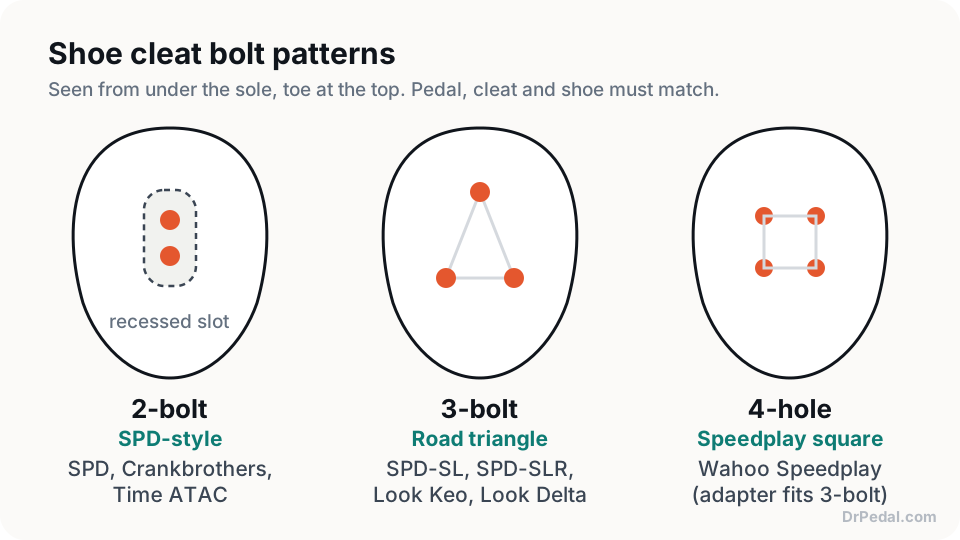
| System | Cleat | Where it wears | When to replace |
|---|---|---|---|
| Shimano SPD | 2-bolt, metal | Front and rear engagement edges | When the edges round off or release changes |
| Shimano SPD-SL | 3-bolt, plastic | Front tab, rear edge, walking surfaces | Once the colored wear portions are worn (Shimano) |
| Look Keo Grip | 3-bolt, plastic with grip pads | Contact edges and grip pads | As soon as any wear indicator shows (Look) |
| Wahoo Speedplay | 4-hole, holds the spring | Spring, body and walking surfaces | Every 3,000–5,000 miles, sooner if visibly worn (Wahoo) |
| Crankbrothers | 2-bolt, brass | Wings and contact edges | When engagement loosens or release changes |
SPD cleats are steel and sit in a recessed sole, so they last a long time, but they do wear. Look at the front and rear lips that hook into the pedal: they start square and wear round.
Signs to act on:
Before blaming the cleat, check the pedal’s tension screw hasn’t backed off. Also check the shoe: when the sole tread wears down, the cleat stands proud and gets ground on every walk. Fresh tread or a cleat shim from cleat hardware fixes that. The single-release SM-SH51 and multi-release SM-SH56 wear the same way.
Shimano’s instructions say to replace SPD-SL cleats once their colored portions are worn, such as the yellow on the SM-SH11 or the red on the SM-SH10, and retailers describe these as wear indicators. Walking is the main cause, because a road cleat is the only thing touching the ground.
Also watch for a front tab that’s chipped or thinned, a rear edge worn to a slope, and a cleat that rocks on the pedal. Newer SPD-SLR pedals use their own CL-SL110 cleat, which retailers list as not compatible with SPD-SL pedals, so check that you’re buying the right one and follow its instructions.
Look’s Keo Grip cleats have built-in wear indicators, and Look says it’s dangerous to keep using them once one or more indicators are visible. Look also lists unusual squeaks at the pedal and cleat, and grip pads that feel slippery when walking, as signs of wear.
Look notes that dust, mud and sand are abrasive and speed up wear, and that the more you walk, the faster the cleats go. Check the gray, black or red color you’re replacing so the float stays the same: black 0°, gray 4.5°, red 9°. Look Delta cleats, used on older Look pedals and Peloton bikes, are a different cleat and don’t fit Keo pedals.
Wahoo publishes a mileage interval for Speedplay cleats: replace them every 3,000–5,000 miles (5,000–8,000 km). Wahoo adds that real life varies with rider weight, riding surface and how often you ride, that you should replace them sooner if parts show advanced wear, and that you should never ride damaged or excessively worn parts.
Speedplay is different from every other system because the spring that holds you in lives in the cleat. That means a worn or grit-packed cleat affects engagement and release, not just feel. Wahoo recommends replacing all the cleat’s parts together, base plates included, rather than mixing old and new, and suggests a dry PTFE lubricant on the cleat springs. The Standard Tension cleat is the usual replacement; the gray Easy Tension cleat swaps in if you want a lighter release.
Crankbrothers cleats are brass, so the cleat is meant to wear before the pedal’s contact points do. As they wear, the release angle drifts and engagement gets looser, so watch for exits that feel different from when the cleats were new.
Know what you started with: the Standard cleat releases at 15° or 20° depending on which foot it’s on, while the Easy Release cleat releases at 10°. If release feels easier than it should on Standard cleats, check they haven’t been swapped left to right before deciding they’re worn. Also check the bolt heads: once they’re chewed, you can’t adjust or remove the cleat cleanly, so replace chewed bolts along with the cleats.
Rule out the easy causes before buying cleats:
Walking is the biggest single cause of road-cleat wear. Every step grinds the plastic on pavement, and grit in parking lots and cafés works into the edges.
Keeping cleats clean helps every system. Rinse off mud after a ride, and don’t walk across sand or gravel in road cleats if you can avoid it.
There’s no universal mileage. Shimano and Look point you to wear indicators on their road cleats; Wahoo gives 3,000–5,000 miles for Speedplay and still says to replace sooner if the cleats are visibly worn.
In practice:
For a fresh setup rather than a straight swap, follow how to install clipless pedals and cleats, and use a cleat fitting tool if you want to copy a position exactly. Compare every cleat and its float in our bicycle cleats guide.
There's no single answer: it depends on the system, how much you walk and what you walk on. Wahoo gives 3,000–5,000 miles (5,000–8,000 km) for Speedplay cleats, varying with rider weight, surface and use. Metal SPD cleats in recessed shoes generally outlast plastic road cleats.
The cleat releases more easily than it used to or lets go when you pull up, there's more side-to-side play, and the front and rear engagement edges look rounded rather than square. Check the pedal's tension screw first; if it's unchanged, the cleat is the likely cause.
Yes. Both feet should release the same way, and a new cleat on one side and a worn one on the other makes your exits unpredictable.
They can contribute. A worn cleat lets the foot rock or shift away from the position you set. If knee discomfort starts as your cleats age, replace them and recheck the setup; see cleat float explained.
Clean both, check the cleat bolts and the pedal's release tension, then fit new cleats. If the problem stays with new cleats, the pedal's contact surfaces or spring are worn.
Yes, for road cleats. Most road-cleat wear comes from walking, and covers take that wear instead. They matter most on Speedplay cleats, where the spring lives in the cleat; see cleat covers.