Magnetic vs clipless pedals: a clipless pedal locks a cleat in a spring-loaded binding and only lets go when you twist your heel out, while a magnetic pedal such as Magped pulls a steel shoe plate onto the platform and lets go in any direction once you twist or pull harder than the magnet holds. Clipless gives the firmer, more predictable hold for racing and hard riding. Magnetic suits riders moving up from flats, riders nervous about being clipped in and anyone who wants an easier exit. Both use 2-bolt SPD-style shoes.
Independent & reader-supported. DrPedal doesn't sell anything. If you buy through our Amazon links we may earn a commission at no extra cost to you — as an Amazon Associate we earn from qualifying purchases. How we make money.
Pedals to compare
Chosen on compatibility, specs and design — not sponsored. Amazon buttons open a search for the exact model.
Best for: Trail riders up to about 80 kg moving up from flats
Magped's large pinned trail platform, CNC-machined from one aluminum block. Magped recommends the 150N magnet for riders up to 80 kg; the 200N version is for riders over 75 kg.
Best for: Trail and e-MTB riders who want a mechanical lock
A pinned enduro platform around Crankbrothers' four-sided clip-in mechanism, with a long spindle for heel clearance. Same 2-bolt shoes as a Magped, but a true cleat lock.
A magnetic pedal has a strong permanent magnet set into the middle of a platform pedal, usually surrounded by pins. A steel plate bolts to your shoe where an SPD cleat would go. Put your foot down and the magnet pulls the plate onto the pedal.
Magped rates its magnets in newtons, which describes the pull-off force: 150N is roughly the force needed to lift a 15 kg weight. Magped also notes that real-world hold depends on magnet size, dirt, wear and the direction of force. A straight pull away from the magnet meets the full rating, while a twist or a rolling exit takes less effort.
Nothing latches. That is the whole point, and the main limit.
How a clipless pedal holds your foot
A clipless pedal has a spring-loaded binding that snaps around a cleat on the shoe. Once clipped in, your foot stays attached whatever direction you push or pull, until you twist your heel outward past the release angle.
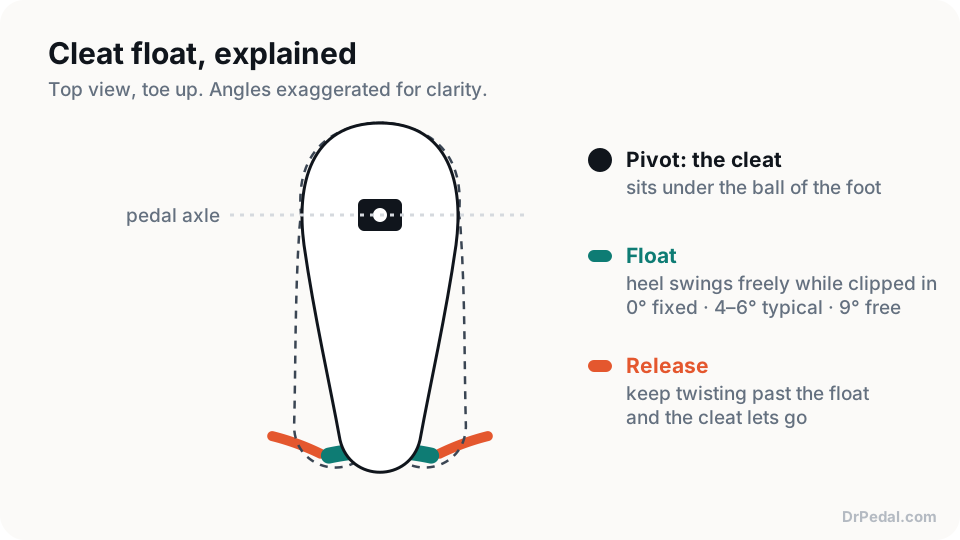
Clipless float: the heel swings freely through a set arc, then the cleat releases. Magnetic pedals have no fixed arc or release point.
On most SPD and road pedals you set how hard that twist is with a tension screw. Crankbrothers pedals have no screw: the cleat sets the release. The one common exception to “twist only” is Shimano’s SM-SH56 multi-release SPD cleat, which also releases with a lift and twist.
Retention vs release: the real trade-off
Clipless gives you a hold you can count on; magnetic gives you an exit you can count on.
Where clipless is stronger
Hard efforts: sprinting, steep climbing out of the saddle and high-cadence spinning never unseat a properly adjusted cleat.
Big hits: a heavy landing or compression won’t pull your foot off.
Lifting the bike: you can pull the bike up with your feet.
Predictability: the release always happens at the same heel angle.
Where magnetic is stronger
Any-direction exit: you can step off forward, backward or sideways, or simply lift off.
No technique to learn first: there’s no release motion to drill before your first ride.
Normal shoes: without a plate, the pedal works as a pinned flat.
Foot placement: the magnet draws the plate into place, which helps riders whose feet wander on flats.
Choosing magnet strength
Pick the magnet by body weight and terrain. Magped recommends the Enduro2 150N for riders up to 80 kg and the 200N for riders over 75 kg. The Enduro2 150N is the gentler of the two. The Sport2 is also offered with a 100N magnet for lighter riders.
Float and foot position
Clipless float is a defined number; magnetic float is not. A Shimano SPD cleat allows 4° of free heel movement before the release begins, Crankbrothers cleats 6°, and road systems from 0° up to Speedplay’s adjustable 0–15°. Your foot’s position is fixed by where you bolt the cleat.
A magnetic pedal has no float figure to quote. The plate can turn on the magnet, resisted by the magnet’s grip and the pins, until the twist overcomes the magnet. Your foot can also land slightly off-center each time you put it down.
That freedom is why some riders with knee concerns like magnets: nothing holds the foot at a set angle. If knee pain is the reason you are looking, get a bike fit first; the cause may be cleat position, and our cleat float explained guide covers how float helps.
Shoes and plates: the 2-bolt connection
Both systems use the same shoe: a 2-bolt SPD-compatible sole. That makes switching between them easy.
Magnetic: the steel plate bolts into the cleat slots with 2 screws. Magped recommends flat-soled SPD shoes with a fine to medium tread, because very deep lugs around the cleat area can hold the plate away from the magnet.
SPD-style clipless: the cleat sits in the same slots, recessed into the sole so you can walk. Mountain bike shoes with deep lugs are fine, as long as the cleat can reach the binding.
Road shoes: 3-bolt road shoes fit road clipless systems only. They don’t take a magnetic plate.
To try both, keep one pair of 2-bolt shoes and swap plate and cleat. Mark the cleat outline on the sole before you remove it. Spare cleats and hardware are in our cleats guide.
Who each suits
Choose magnetic pedals if you
ride flats now and want your feet to stay planted on rough trails without learning to clip out;
have tried clipless and never got comfortable with the exit;
ride an e-bike or commute in stop-start traffic and want to step off in any direction;
sometimes ride the same bike in normal shoes.
Choose clipless pedals if you
ride road, gravel or XC, especially fast or long;
jump, bunny-hop or sprint hard and want your feet to stay attached;
want a wide choice of pedals, cleats and shoes, including road systems;
want the lightest option: magnets add weight.
If you are new to clipless, multi-release SM-SH56 cleats or Crankbrothers Easy Release cleats narrow the gap considerably. See best clipless pedals for beginners.
Limits of magnetic pedals
Know these before you buy:
No mechanical lock. Magped itself says there’s no firm connection comparable to clipless. A hard yank or big compression can pull a foot free.
Dirt reduces hold. Mud between plate and magnet weakens the grip, and magnets collect ferrous grit. Wipe both after wet rides.
Plate wear. Inspect the plates and their screws regularly.
Weight. Magnetic pedals are heavier than most clipless pedals.
Limited choice. There are far fewer models, and almost no road options.
Limits of clipless pedals
Clipless has its own drawbacks:
A fixed exit. You must twist out; you can’t just lift off. It takes a few weeks to become automatic, and the slow topple at a standstill is a rite of passage. Our clip in and out guide shortens the learning curve.
Cycling shoes only on most models.
Cleat wear and setup. Cleat position affects knees, and cleats need replacing.
Other middle-ground options
If neither feels right, there are other ways to get partial retention:
For Magped’s lineup and how its models differ, see the Magped brand page.
FAQ
Are magnetic pedals as good as clipless?
+
Not for maximum hold. A clipless pedal locks the cleat mechanically, and Magped itself says its pedals have no firm mechanical connection like clipless. Magnetic pedals are better than flats for keeping your foot planted, with an easier exit than clipless.
Can you pull up on magnetic pedals?
+
A little. The magnet resists a gentle pull, but a hard pull, like a sprint or a bunny hop, can lift the plate off. Clipless pedals let you pull as hard as you like.
Do magnetic pedals work with SPD shoes?
+
Yes. Magnetic pedals such as Magped use a steel plate that bolts into the 2-bolt cleat holes of an SPD-compatible shoe. Magped recommends flat soles with fine to medium tread so the plate can reach the magnet. 3-bolt road shoes don't take the plate.
What magnet strength should I choose?
+
Go by Magped's weight guidance. For the Enduro2, 150N is for riders up to 80 kg and 200N for riders over 75 kg. In the overlap, choose 150N for easier release and 200N for rough, fast trails.
Are magnetic pedals safer than clipless?
+
They are easier to leave in a hurry because they release in any direction without a set motion. The trade-off is that a big hit can also knock your foot off when you don't want it to. Neither is safer for every rider.
Can I switch between magnetic and clipless on the same shoes?
+
Yes, if the shoes have 2-bolt holes. Swap the steel plate for a cleat. Mark the cleat position before you remove it so you can return to it.